Ask most buyers what a Chinese lantern festival looks like and they will describe the same thing: dragons, pandas, red and gold, Lunar New Year. That image is accurate — and it is also the single biggest misconception holding lantern festivals back.
The lantern was invented in China, but light was not. Every culture on earth has built rituals around illumination: candles in windows, oil lamps on water, bonfires on the longest night. A lantern is simply the most sculptural way to express that impulse, and the craft that grew up in Zigong is not a set of Chinese motifs — it is a translation system. It takes any symbol a culture cares about and rebuilds it as a lit, walkable, photographable volume.
This guide is written for festival buyers, city events teams, theme park operators and zoo directors who need their light event to speak to audiences that are not Chinese. It walks through what we have actually built for other cultures, how a cultural symbol becomes a working lantern, and — the part most suppliers never discuss — how to borrow respectfully without getting it badly wrong.
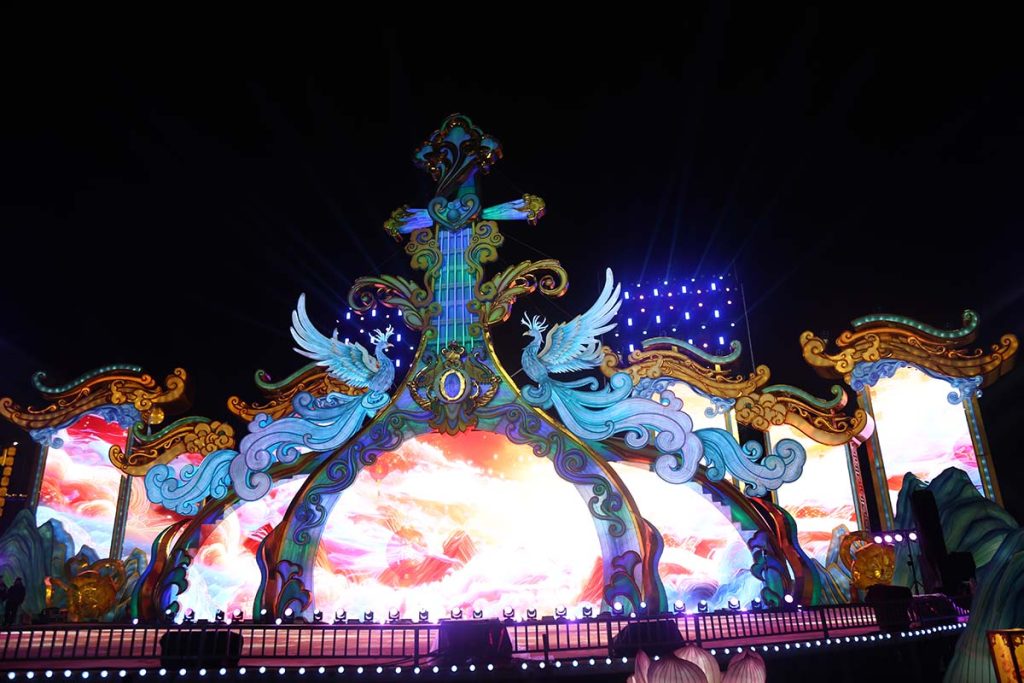
Why Cultural Range Matters to Festival Buyers
Your audience is not one culture anymore. A city light festival in Lyon, Houston or Rotterdam draws residents from a dozen continents of origin. A programme that speaks to only one of them is leaving most of the room unaddressed.
Novelty has a shelf life of about two seasons. This is the practical problem buyers tell us about most. Year one, a Chinese-themed festival is exotic and sells out. Year three, the same dragon archway is familiar, press coverage drops and repeat visitation flattens. Cultural range is what keeps a fourth season viable — you can rotate themes without rebuilding the event from scratch.
Sponsors buy recognition. A brand sponsor funds what its customers recognize. A lantern set that includes the client region’s own landmarks and stories is dramatically easier to place with a local sponsor than a purely imported programme.
Schools and cultural institutions want curriculum value. Museums, botanic gardens and zoos increasingly treat light trails as education programming. Multicultural content gives teachers a reason to book a group visit on a Tuesday in November.
How a Culture Becomes a Lantern: Five Translation Steps
Understanding this process is what lets you brief us well. It is also why “just send us a picture of what you want” is the least efficient way to start.
1. Research before drawing. We begin with the symbol’s meaning, not its shape. What does this figure represent, when is it displayed, what colours are conventional, what is sacred and therefore off-limits? A motif that is decorative in one culture can be religious in another, and the difference matters.
2. Choose the readable silhouette. Lanterns are read at distance, in darkness, often from a moving walk. The design has to survive being reduced to an outline. This is why animal forms, architectural landmarks and figures with strong props translate best, and why dense flat pattern usually does not.
3. Build volume, not a flat picture. A lantern is sculpture. Depth, layered planes and internal light give it presence from every angle. Anything that only works head-on will disappoint in a route where people circle it.
4. Plan the colour for night, not for screen. Palettes shift after dark. Deep reds go brown, pale yellows blow out, and blues lose detail. We specify lighting alongside surface colour so the piece looks right under its own light, not under a studio lamp.
5. Decide where motion and interaction belong. Not every culture’s imagery wants animation. A sacred animal may read better held still; a folk character may come alive with a turning head or a waving arm. Motion is a decision, not a default.
East Asia Beyond the Dragon: Japan, Korea and Shared Symbolism
East Asia is where buyers assume the range ends, and it is actually where the most interesting nuance lives — because these cultures share a visual vocabulary while using it differently.
Japan. The clearest example in our catalogue is the giant Japanese koinobori fish lantern. Koinobori — carp streamers flown for Children’s Day in early May — carry a meaning that travels well: the carp swims upstream and becomes a dragon, so the fish stands for perseverance and ambition for children. None of that is Chinese iconography, yet the form is perfectly at home in lantern craft: a hollow body, a mouth that takes light, fins that read as silhouette.
Japanese themes also lean on cherry blossom, cranes, Mount Fuji, and a restrained palette — indigo, white, soft pink — that behaves very differently from the saturated red-and-gold of Lunar New Year. A Japanese zone in a festival should feel quieter than the Chinese zone next to it. That contrast is a design asset.
Korea. Korean visual language offers dancheong — the five-colour decorative painting found on temple architecture — along with the tiger and magpie pairing of folk painting, and the moon jar form. These are distinct enough to build a recognizably Korean section without borrowing from neighbours.
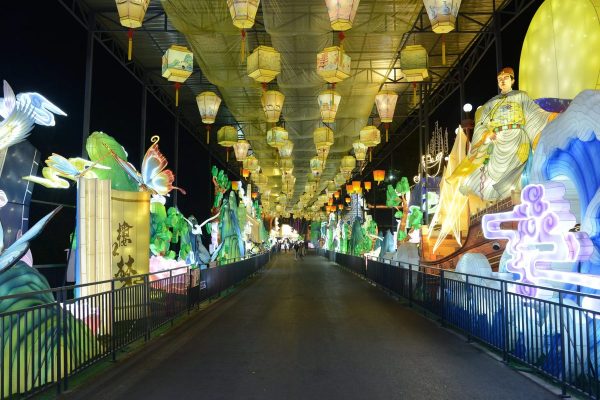
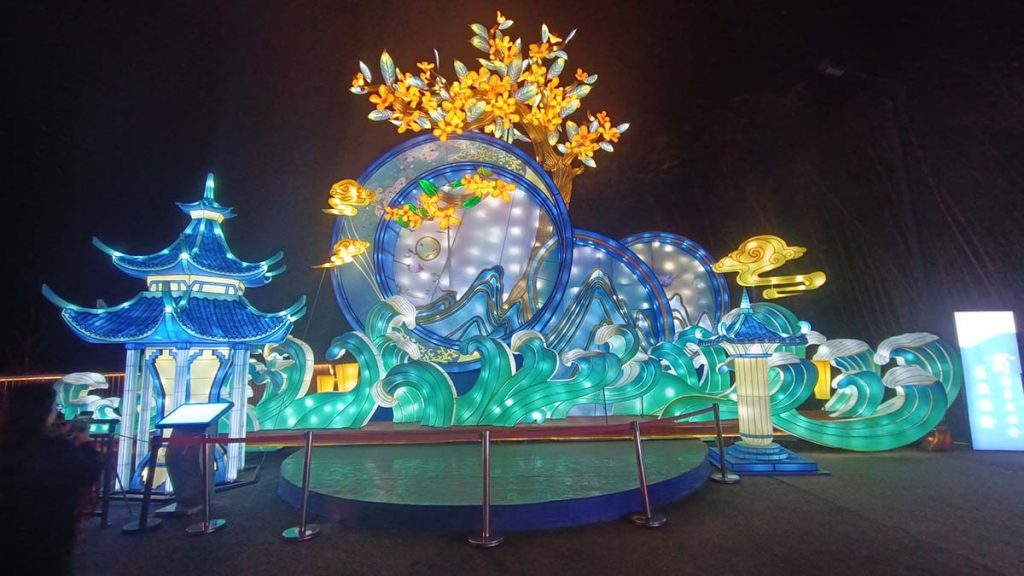
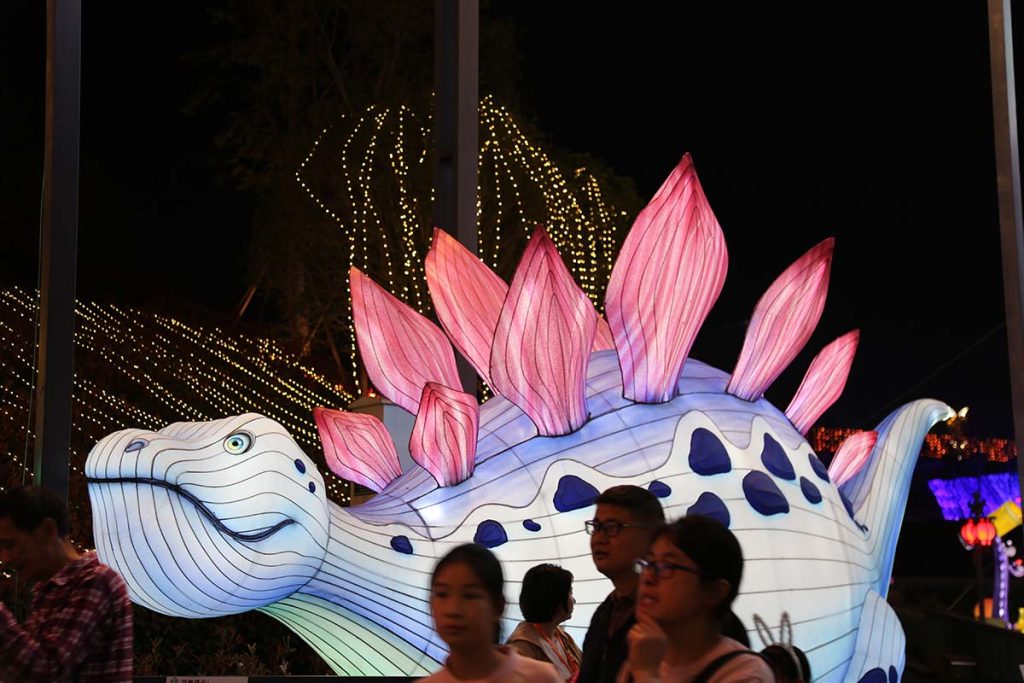
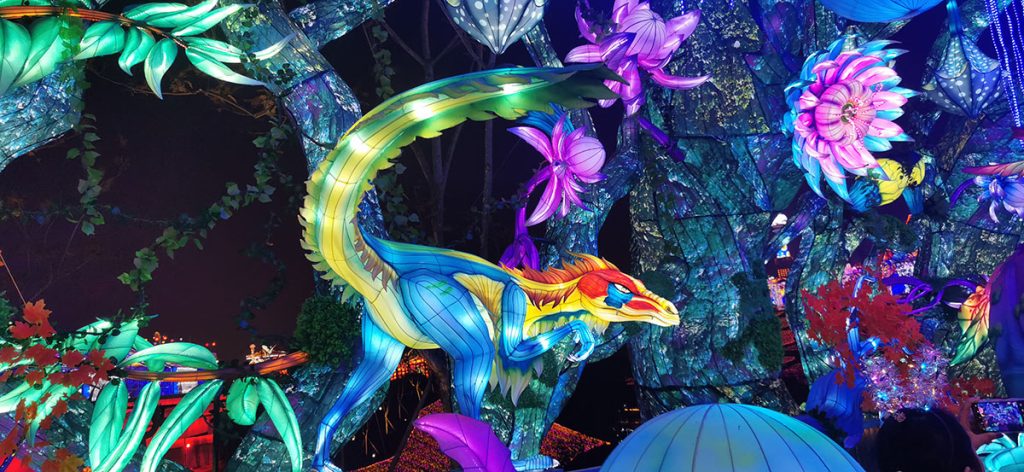
China, properly. It is worth saying that “Chinese” is not one style either. Our catalogue spans the courtly and the archaeological: the Chinese dragon lantern, the Sanxingdui bronze mask from the ancient Shu civilization, the feitian apsara of Dunhuang, Peking opera characters, Hua Mulan, the Monkey King, and the Mid-Autumn moon palace. A buyer who wants “Chinese” is really choosing between at least five visual traditions.
South and Southeast Asia: Festivals of Light, Elephants and Peacocks
If there is one region where lantern craft is an almost suspiciously natural fit, it is South Asia — because the region already has a festival built entirely around light.
Diwali as a design brief. Diwali, the festival of lights observed by Hindu, Sikh and Jain communities, centres on rows of small oil lamps placed to mark the victory of light over darkness. Rows of light, arranged along a route, guiding people forward — that is structurally what a lantern trail already is. The design opportunity is not to reproduce Diwali but to borrow its grammar: repetition, warm points of light at low level, rangoli-style floor patterns translated into lit ground elements.
Animals that carry meaning. The elephant is revered across India and Thailand and appears in our catalogue in forms such as the geometric LED elephant lantern. The peacock, India’s national bird, is one of the few motifs that works equally well as pure colour and as silhouette — see the peacock feather rock lantern.
The shadow-puppet advantage. Wayang kulit, the Indonesian shadow-puppet tradition, produces flat, highly articulated figures with pierced outlines. Those piercings are exactly what a lantern wants: light passes through the cutwork and the figure reads as glowing line. Southeast Asian themes convert to lantern form unusually well for that reason.
Design note. South and Southeast Asia are religiously diverse and visual symbols carry specific commitments. A lotus is safe nearly everywhere; deities are not. We will ask, early, which traditions your audience actually observes.
The Middle East: Geometry, Genies and Desert Nights
Middle Eastern themes are in growing demand for winter events, and they reward a designer because the region’s decorative tradition is already built around pattern, light and nights spent outdoors.
Storytelling figures. The genie of the lamp — the figure that reached global audiences through the Arabian Nights — is one of the best-behaved subjects in lantern form: smoke-like volume, a lamp as a light source, a shape that reads instantly. Our Aladdin’s lamp genie figure is built on exactly that logic.
Geometry instead of imagery. Islamic decorative tradition developed extraordinary non-figurative pattern — arabesque, eight-point stars, muqarnas-inspired faceting. Translated into lantern panels and archways, this produces some of the most sophisticated surfaces we build, because the pattern itself becomes the light source. Facets catch internal light differently as visitors move, so the piece appears to shift without any electronics beyond the lighting.
Colour and setting. Cobalt, turquoise, brass and deep lapis read beautifully at night and separate a Middle Eastern zone cleanly from an East Asian one fifty metres away. Desert settings — date palms, crescent moons, caravan silhouettes — give the zone a horizon line that most festival sites lack.
Where we draw the line. We do not produce figurative depictions of religious figures. This is not caution for its own sake: it is the difference between a display that welcomes a community and one that offends it on opening night.
Europe: Landmarks, Legends and Winter Light Traditions
Europe is the easiest region to underestimate, because buyers assume a Chinese supplier cannot do it credibly. The test is not whether we know what the Eiffel Tower looks like — it is whether the proportions, the lattice density and the way the structure actually meets the ground are right.
Built landmarks. Architectural subjects demand accuracy more than any other category. Our Eiffel Tower lantern installation is designed to the real elevation: the curve of the legs, the platform positions, the lattice rhythm. Get those wrong and the piece reads as a cartoon, which is precisely the failure mode buyers fear.
Myth and chivalry. Greek and medieval European material is plentiful and visually strong — winged horses, knights, heraldry, castle gates. The knight with Pegasus and the knights alliance scene show how much narrative a single figure grouping can carry.
Fairy tales as route content. European folk tales are, practically speaking, the most efficient content for family routes: every child already knows the story, so no explanation is needed. Our Little Red Riding Hood scene works because the wolf, the basket and the forest are legible in silhouette alone.
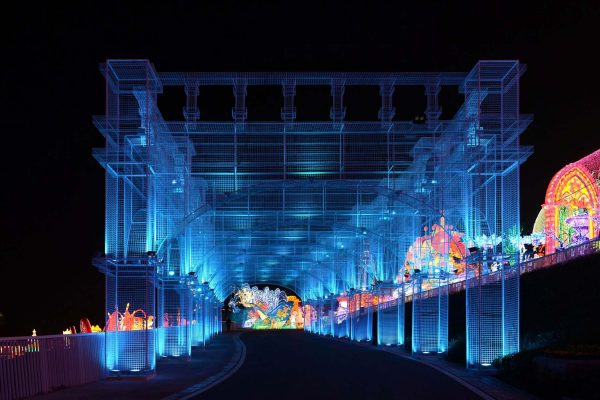
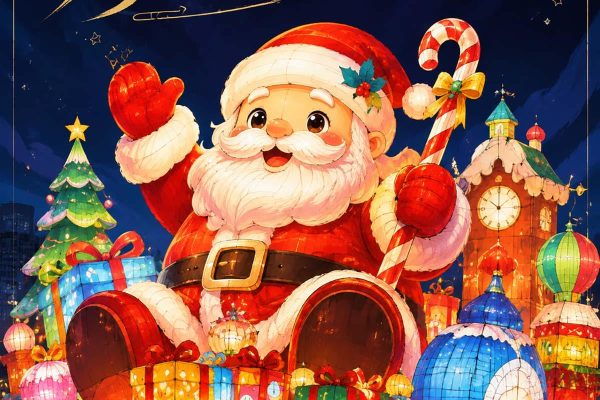
Winter and Christmas. Northern Europe and North America have their own established light season, and it is not a lantern festival — it is Christmas markets, Advent light, winter trails. We build for that calendar directly, from Santa’s sleigh to full walk-through archways. The commercial logic is strong: it lets a site run a paid light event in the one season when outdoor footfall is otherwise dead.
Africa: Safari Wildlife and the Power of Silhouette
African themes in lantern form succeed on two things: animal silhouette and pattern.
Wildlife first. The savannah animals are among the strongest silhouettes in the entire animal kingdom — the giraffe’s neck, the lion’s mane, the zebra’s stripes, the rhino’s horn. They are unmistakable in outline and they photograph well. Our safari lion and giraffe set and life-size zebra sculpture rely on exactly that.
Pattern as surface design. West and Southern African decorative traditions — Adinkra symbols from Ghana, Ndebele wall painting from Southern Africa, mudcloth geometry — give a lantern surface a graphic identity that is clearly not generic “tribal” styling. Used properly, with attribution in your signage, pattern of this kind is what elevates a zone from decoration to interpretation.
What to avoid. “Africa” is not one culture, and a set that mixes Maasai, Zulu and Egyptian imagery into a single visual soup is both inaccurate and increasingly called out by visitors. Pick a region, name it on the signage, and design to it.
The Americas and Oceania: Polar Ice, Rainforest and Outback
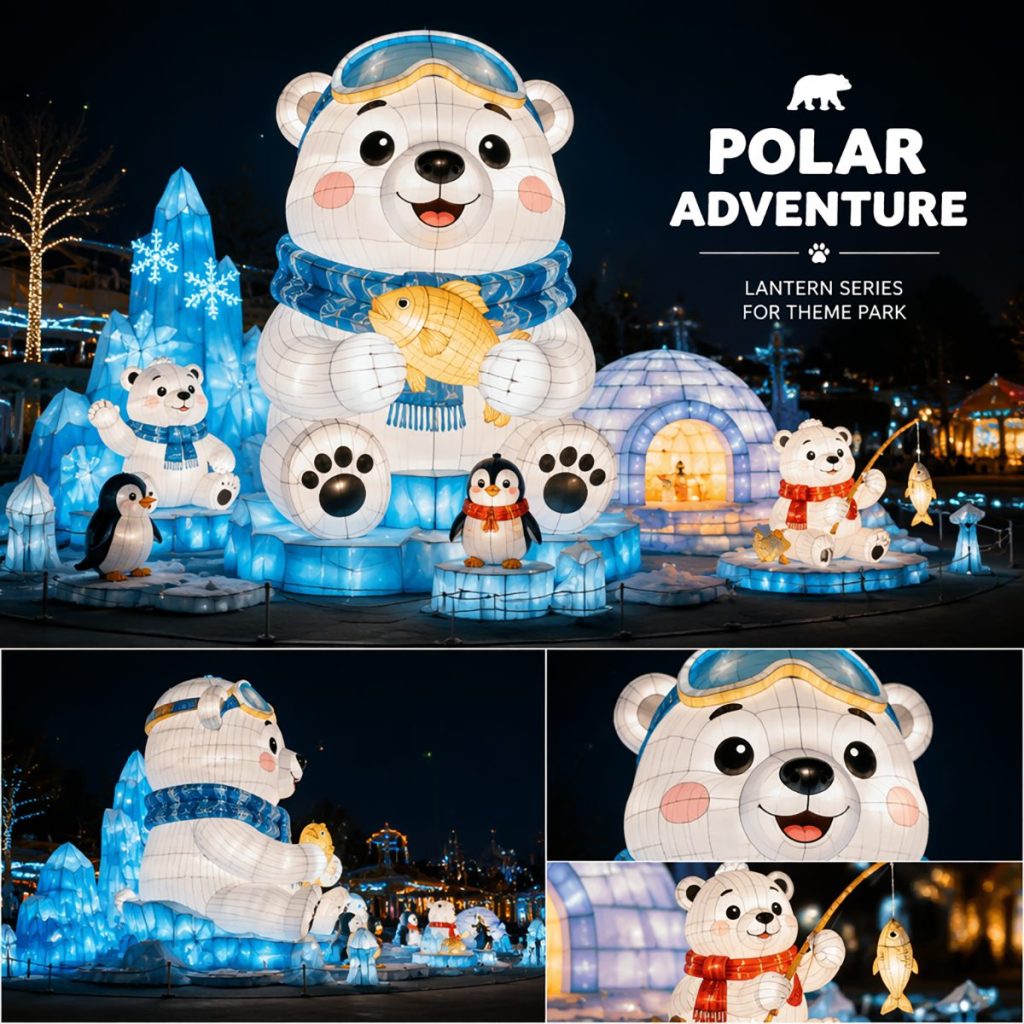
North America. The most requested North American content is not urban — it is wilderness and winter. Moose, bear, wolf and polar subjects suit cold-climate events running from November into January. Our moose light sculpture and polar bear iceberg lantern sit in that winter-light register.
Indigenous art of the Pacific Northwest — formline design, totem poles, crest animals — is visually superb and culturally owned. It is the clearest case where a buyer should commission with the relevant Nation’s involvement rather than treat the imagery as public-domain decoration. We are glad to build to a design that a community has approved; we will not invent one.
Latin America. The region offers two opposite registers that both work: the saturated folk-art colour of Mexican paper picado and alebrije creatures, and the deep-green rainforest register of the Amazon with macaws, jaguars and anaconda forms. Both translate to lantern light very differently, which is useful — they can sit in separate zones without competing.
Oceania. Australian content is dominated by its animals, and our animatronic koala is a good example of how a single recognizable species can anchor a whole zone. New Zealand’s Māori visual language — the koru spiral, kowhaiwhai patterns — is another instance where community sign-off matters and where doing it properly produces something genuinely beautiful.
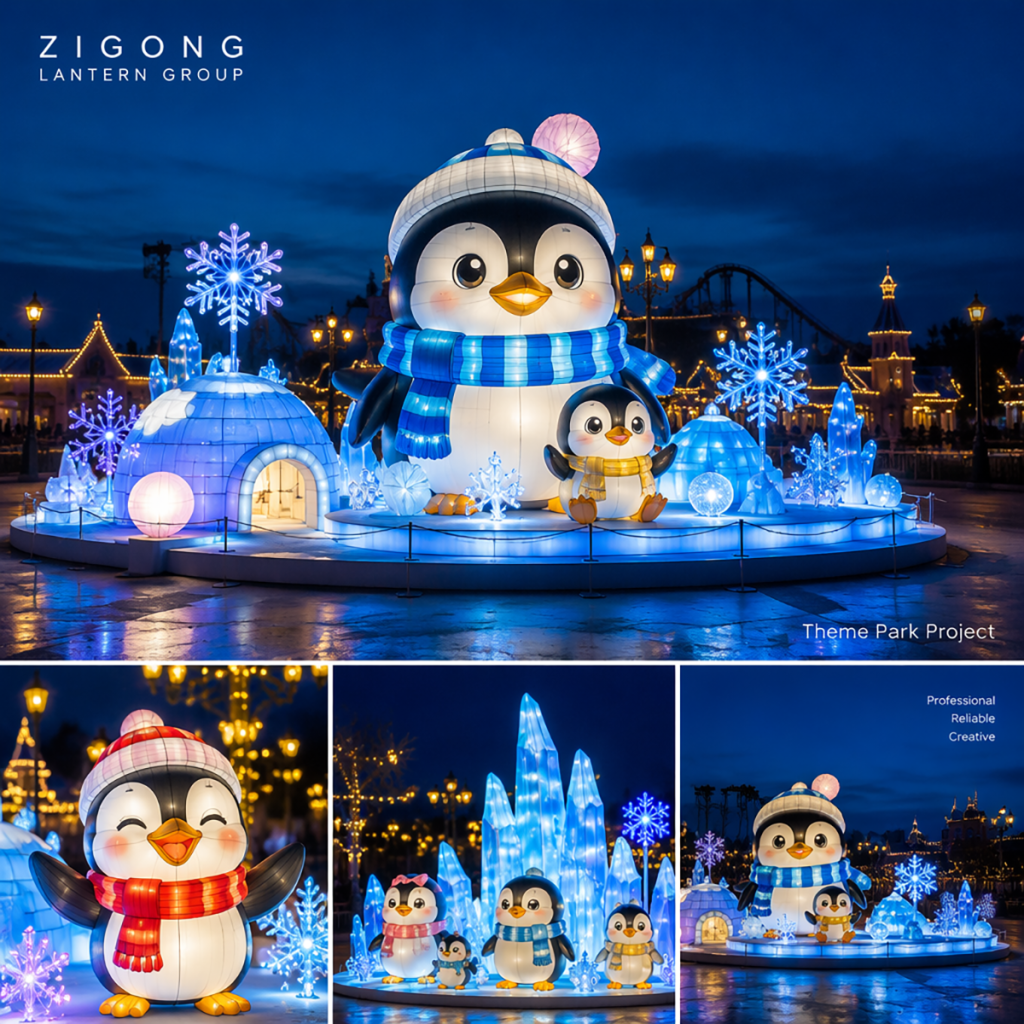
Polar content travels: the penguin colony and igloo set works for Southern Hemisphere buyers as comfortably as Northern ones.
Pop Culture and Fantasy: When There Is No Folk Tradition to Borrow
This is the section that settles the argument. If a workshop can only do folk tradition, it is limited to imagery that already exists. The harder test — and the one that proves real design range — is inventing for stories that have no craft lineage at all.
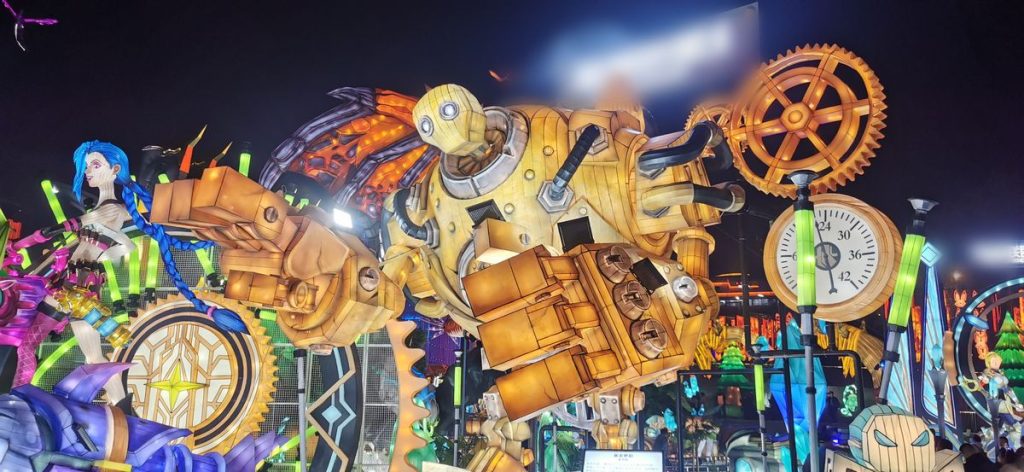
Anime and gaming. Japanese animation and game properties are now mainstream content for light events, particularly with audiences under thirty. Our anime character display and the League of Legends mecha installation were built to licensed designs supplied by the rights holder — which is the correct way to do this, and the only way we will do it.
Steampunk and cyberpunk. These are invented aesthetics rather than inherited ones, which makes them demanding: there is no reference library, only a set of conventions. Victorian brass and gear language defines the steampunk wonderland; neon and hard-edged geometry define the cyberpunk characters. Both are among the most photographed pieces we build.
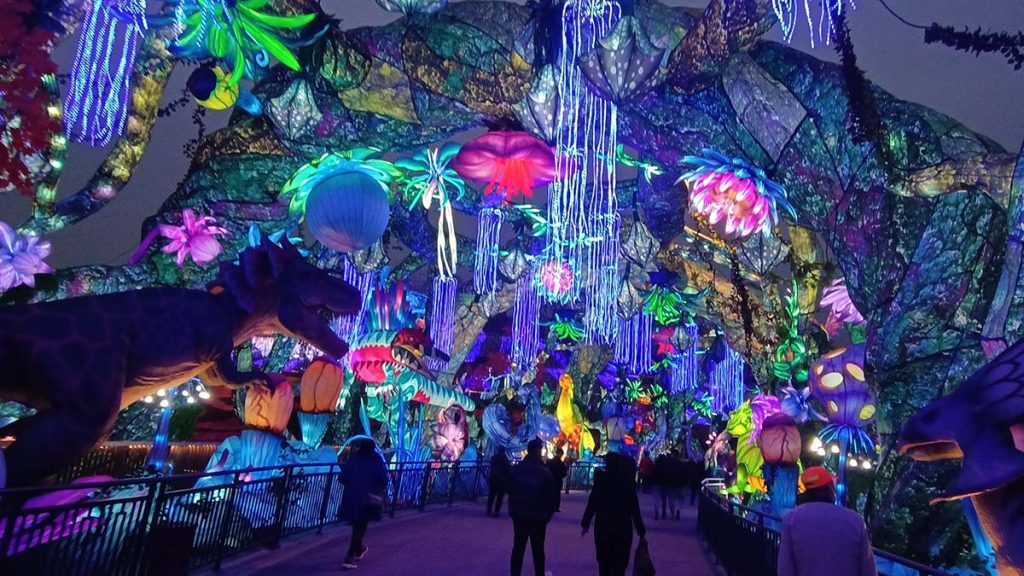
Original fantasy worlds. Sometimes the brief is a world that does not exist yet — a forest of glowing owls, an ocean tunnel of elves and jellyfish. The magic forest owl and the fantasy ocean archway come from that kind of brief, and they are often the pieces that give a festival its own identity rather than a borrowed one.
Cultural Accuracy: How We Avoid Getting It Wrong
Most suppliers will not raise this. We raise it early, because getting it wrong has real consequences — it is a news cycle, an angry community group and a sponsor pulling out.
We will ask what is sacred. Before design starts, we ask which symbols in your brief carry religious or ceremonial weight. Those get treated differently: no figurative depiction, no animation, no commercial adjacency.
We design to named sources, not to “style”. If a motif belongs to a specific people, region or community, the design references that source specifically and your signage credits it. Vague pan-continental styling is where most offence happens, and it is also where most design quality is lost.
We are glad to work with your community consultants. Several of the most successful multicultural festivals we have supplied were designed with local cultural associations reviewing concepts before fabrication. That review loop catches problems a designer five thousand kilometres away cannot see.
We will not replicate living artists’ work. If your reference image is a contemporary illustrator’s piece, we need either their permission or a different reference. This protects you as much as it protects them.
Licensed characters are licensed. We manufacture to artwork you have the rights to use. We do not copy characters from studios, games or franchises, and we are happy to sign non-disclosure agreements on licensed projects.
Planning a Multicultural Route: Proportions, Pacing and Signage
A multicultural festival fails in one of two ways: either it becomes a random international buffet with no structure, or it gets so cautious that every zone looks the same. The fix is structural rather than artistic.
Work to rough proportions. A dependable split for a diverse city audience is roughly 40% local and regional heritage, 40% world cultures chosen for your audience mix, and 20% universal or fantasy content that belongs to no one and offends no one. The last 20% is doing quiet work: it is the photographic material that carries your social reach.
Zone it hard. Culture reads through contrast. A Japanese zone should feel quieter and cooler than the Chinese zone beside it; a safari zone should open up spatially after a tight European street scene. Changing light temperature, spacing and colour between zones does more for visitor comprehension than any signage.
Give each zone one landmark and one photo moment. A landmark gives people a destination and a meeting point; a photo moment gives them a reason to stop and share. Our festival photo spot exists for exactly this purpose in a route.
Put interpretation on the route, not in a brochure. Two or three lines per piece — what it is, where it comes from, why it matters — converts a pretty light into an experience people talk about the next day. Multilingual panels, in the languages your city actually speaks, are the cheapest credibility you can buy.
Plan the second year now. Design the structure so zones can be re-skinned. Our gift box lantern kiosk is the clearest example: the trading structure stays and the themed skin changes, so year two does not mean rebuilding the structure from scratch.
What We Need From You to Start a Cultural Design
Cultural projects go smoothly when the brief is specific about people rather than pictures. Five things get us to a useful concept fastest:
1. Who is actually coming? The demographic mix of your audience — by community, not just by age — determines which cultures belong in the route.
2. Which cultures, and how deep? A list of three to six is usually right. Fewer looks thin; more turns into a flag parade.
3. What is off-limits? Tell us what your community or sponsor would consider sensitive. We would rather design around a constraint than discover it at opening.
4. Site plan and route. Dimensions, circulation, power positions and ground conditions. Culture has to fit the site, not the reverse.
5. Dates and season. A winter event and a summer event want different palettes and different light levels, and cultural calendars matter — a Lunar New Year opening date carries expectations of its own.
From there the sequence is straightforward: concept and 3D visualisation, cultural review with whoever you nominate, detailed design, production, shipping and installation by one team. You can start that conversation on our custom lantern manufacturer page or send a brief directly through the quote request form.
FAQ
Can you make lanterns that are not Chinese at all?
Yes. A large share of what we build is non-Chinese: Japanese koinobori, European landmarks, Middle Eastern genies, safari wildlife, Christmas and winter themes, and licensed pop-culture characters. The craft is a manufacturing method, not a style.
Do you copy characters from films, games or anime?
No. We manufacture to artwork that you hold the rights to use, supplied by the rights holder or their licensee. If you have a licence, we build to it and are glad to sign an NDA. If you do not, we design an original character in that spirit instead.
How do you research a culture you have not worked with before?
We start from the meaning of the symbol, then its conventional colours and forms, then what is restricted. Where a motif belongs to a specific community, we design to named sources and recommend that your local cultural partners review the concept before production.
Can the same lantern set be re-themed for next season?
Often yes, and it is one of the strongest arguments for planning structure carefully. Support structures, power and layout can stay in place while surfaces, colour and graphics change — which is how operators keep a fourth season financially viable.
Do you ship and install outside China?
Yes. Pieces are packed as numbered modules for standard containers, shipped to site, and installed by our own crew or supervised by us with a local team. Installation planning starts at design stage, not after production.
Can signage and lettering be bilingual or in our language?
Yes. Marquee lettering, name plaques and interpretation panels are produced in any language and script, including bilingual layouts with Latin and non-Latin text side by side.
What about religious or sacred symbols?
We do not produce figurative depictions of religious figures, and we treat sacred motifs differently from decorative ones — no animation, no commercial adjacency. Tell us early what your audience would consider sensitive and we design around it.
How long does a custom cultural design take?
Concept to opening depends on scale and how much original design is involved. As a working rule, allow time for concept development, a cultural review round, production and shipping before your opening date — and involve us earlier rather than later, because the review stage is what protects your opening.
Related Products & Resources
- Giant Japanese Koinobori Fish Lantern — Children’s Day carp streamer in lantern form
- Eiffel Tower Lantern Installation — European landmark built to the real elevation
- Aladdin’s Lamp Genie Lantern — Middle Eastern storytelling figure
- Safari Lion and Giraffe Lantern Set — African wildlife silhouettes
- Animatronic Koala — Australian wildlife display
- Polar Bear Iceberg Lantern — polar and winter-light content
- Steampunk Wonderland — invented aesthetic, no folk tradition required
- League of Legends Mecha Installation — licensed pop-culture work
- Flying Apsaras Lantern Gateway — Dunhuang themed entrance
- Chinese Pagoda Lantern — multi-tier festival tower with lotus scene
- Festival Lanterns Collection — the full catalogue
- Chinese Lantern Festival — festival planning and display services
- City Lantern Festival Displays — route planning for urban events
- Custom Lantern Manufacturer — bespoke cultural design service
- Request a free 3D design and quote