Giant Elephant with Sanxingdui Warriors Lantern — Ancient Shu Civilization Theme


Giant Elephant with Sanxingdui Warriors Lantern — Ancient Shu Civilization Theme
Cultural Lanterns A giant elephant carrying Sanxingdui warrior figures is a cultural scene, not an animal piece — the bronze masks are what the piece is actually about. Cultural Lanterns·Built to order·Zigong workshop Why this pairing reads as a story…
Cultural Lanterns
A giant elephant carrying Sanxingdui warrior figures is a cultural scene, not an animal piece — the bronze masks are what the piece is actually about.
Why this pairing reads as a story
The elephant alone is a strong form; the Sanxingdui figures alone are a heritage reference. Put together, the elephant becomes a carrier and the figures become the subject, which is how the piece reads as a narrative rather than as two objects placed near each other. That is the difference between a themed installation and a decorated figure.
Sanxingdui bronze masks are instantly recognisable to a Chinese audience and legible to everyone else as something ancient and ceremonial. That double read is why the theme works at a public festival where the audience is mixed.
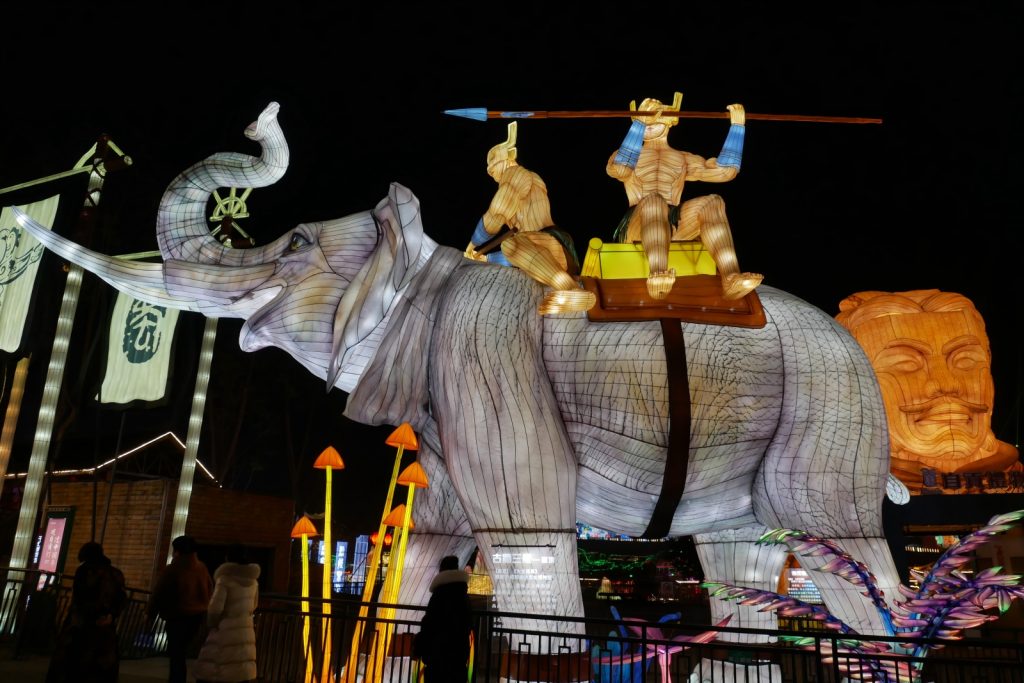
The masks and how they are built
Bronze-look masks cannot be painted onto a flat surface without looking like a print. They are built as shaped elements with depth around the eye sockets and the ear forms, finished in a metallic tone that catches light differently across the face. At night the light is set to graze the mask rather than flood it, because grazing light is what produces the patina effect.
The figure group sits above the elephant’s load line, so the masks are seen at eye height for an adult visitor — which is where the detail has to hold.
Structure and load
Carrying figures means the elephant frame is engineered for a distributed load above the shoulders rather than only for its own weight. The support runs through the body to the base, so the figures do not sit on a decorative shell. That structural decision is made before the design is drawn, not after.
The base footprint follows the combined centre of gravity. A piece built like this cannot be scaled down without re-engineering the frame, which is why the build is sized once for the site.
Where a cultural scene belongs
Heritage-themed scenes are usually placed at an entrance or at the head of a cultural zone, where the reference is read before the rest of the trail sets a different tone. They also suit museum forecourts, heritage districts and city programmes built around a specific historical theme.
For an international audience, pairing the scene with a short bilingual label panel is usual — the visual carries the drama, the label carries the reference.
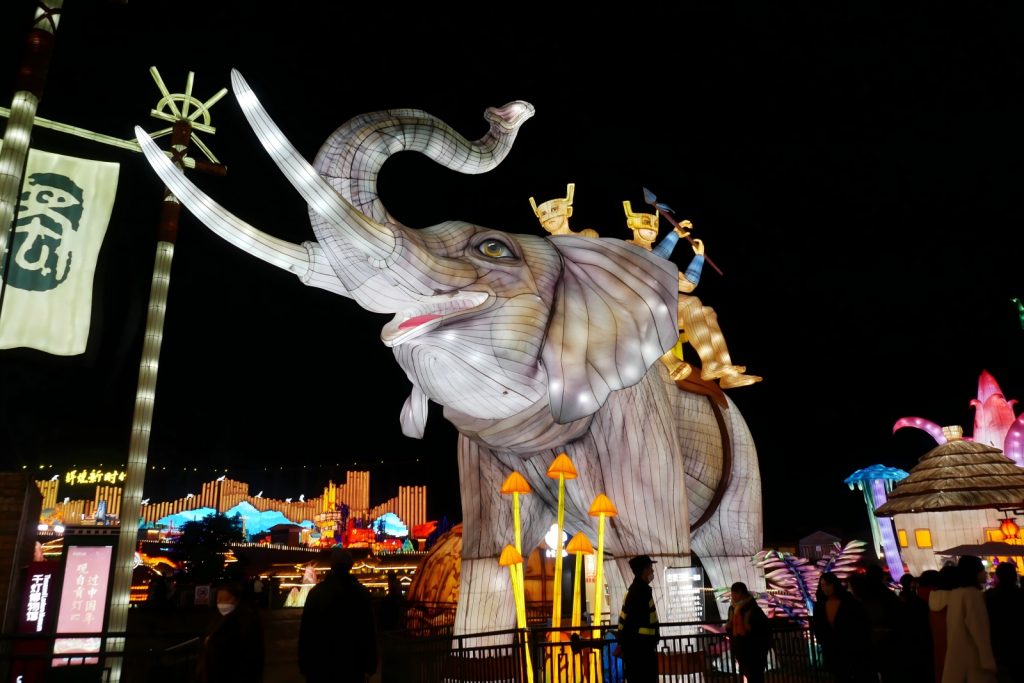
What Sanxingdui Actually Is
International visitors read the masks as ancient and ceremonial without knowing what they are. The reference is worth stating plainly, because it is the reason the piece carries weight.
Sanxingdui is a Bronze Age site about forty kilometres north of Chengdu, in Guanghan. Two sacrificial pits were excavated in 1986, and six more between 2020 and 2022. What came out of them does not look like anything else in Chinese bronze work: no inscriptions, faces with eyes and ears pushed far past human proportion, and a bronze tree almost four metres tall.
The largest bronze mask recovered is about 1.38 metres wide. The most recognisable type has pupils cast as cylinders projecting around 16 centimetres from the eye. That single feature is what people remember, and it is what a lantern version has to get right.
Dating puts the pits at roughly 1200 to 1000 BC, contemporary with the late Shang. The culture is usually called Shu, and the site sits in the same province that later produced Zigong’s lantern craft — which is part of why a scene like this gets built here rather than anywhere else.
Building a Bronze Face Out of Fabric
A mask painted onto a flat panel reads as a print at three metres. Everything about the construction exists to avoid that.
The face is built as separate shaped components rather than one shell: a brow and nose bridge, two eye sockets, two ear forms, and a jaw. Each is formed over its own mould and fixed to the face plate. Eye sockets are set 80 to 120 mm deep, and that depth is what grazing light needs to draw a shadow line.
The ears are the giveaway on this motif. They run wide, two to three times the head width, and they are built as flat planes angled slightly forward rather than as tubes. Built as tubes they read as handles.
The metallic finish is three passes, not one. A bronze base, an oxidised green worked into the recesses, then a pale gold dry-brushed on the high points only. A single gold coat looks like painted plastic under LED, because there is no tonal break between a raised edge and a flat plane.
Lighting is set to graze rather than flood. The fixtures sit at 15 to 25 degrees to the mask surface. Below that the face goes dark; above it the shadows flatten and the depth disappears. That angle is the whole difference between a bronze mask and a gold face.
Sizing a Carrier Elephant and Moving It
The elephant is the carrier, so its dimensions are set by what it has to hold rather than by animal anatomy.
Working range: an elephant 3.5 to 5 metres long and 2.5 to 3.5 metres at the shoulder, with three to five figures at 1.3 to 1.8 metres standing on the back and shoulders. That adds 1.2 to 1.5 metres to the overall height, so a piece like this lands around five metres to the top of the tallest mask.
Load is the reason the frame runs through the body. Each figure runs 40 to 70 kilos and each mask another 20 to 40, so a five-figure build puts 300 to 500 kilos above the shoulders. That load travels down a spine frame into the base, and the base footprint is sized to the combined centre of gravity, which sits higher than on a plain animal.
It ships in pieces: body in three or four sections, legs and tusks separate, figures as individual units, masks unbolted and crated flat. A five-metre build fits a single 40 ft container. Assembly on site takes two to three days with a small lift, and the figures go on last so the body can be levelled first.
Specification
| Item | Detail |
|---|---|
| Type | Cultural scene lantern — elephant with figure group |
| Configuration | Giant elephant carrying Sanxingdui warrior figures |
| Structure | Load-bearing frame through the body to the base |
| Surface | Shaped metallic-finish masks; fabric-covered body |
| Lighting | Grazing LED on the masks, warm wash on the body |
| Rating | Outdoor-rated as standard; indoor builds omit the weather package |
| Scale | Built to order — masks set at adult eye height |
| Installation | Sectioned for container loading; assembled on site |
Related
Cultural heritage lanterns
Heritage-themed scenes and figure groups.
Giant lanterns
Large-scale structures engineered for load and wind.
Request a quote
Send the site and the cultural reference you have in mind.
Building a heritage-themed centrepiece?
Send the reference material and the site position. We will reply with what is buildable at that scale.

You May Also Like
Related Products


Animal Lanterns
Rainbow Gradient Dragon Head Lantern | Chinese Festival Light Sculpture
View Details →
Questions
Frequently Asked Questions
Interested in This Product?
Get a custom quote within 24 hours. Our team is ready to help.