Intangible Cultural Heritage Chinese Dragon


Intangible Cultural Heritage Chinese Dragon
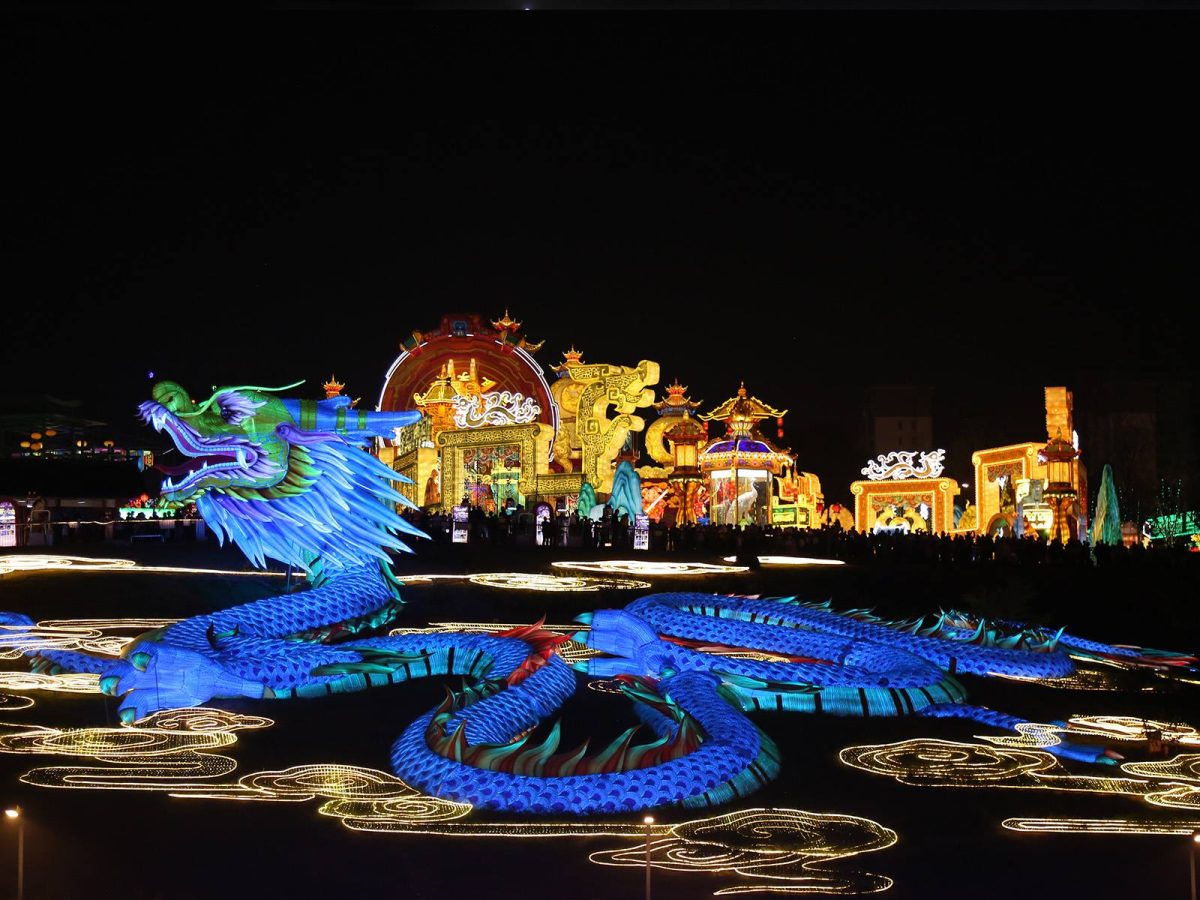
A dragon more than thirty metres long has to be laid out as a route, not placed as an object. On this installation the head rises up to eight metres above the crowd, the body runs in a serpentine wave…
A dragon more than thirty metres long has to be laid out as a route, not placed as an object. On this installation the head rises up to eight metres above the crowd, the body runs in a serpentine wave across the exhibition ground, and the tail carries on toward whatever stands beyond it — so the whole piece is read while walking along it rather than from a single standing point. This giant dragon lantern is built for the exhibition ground rather than the plaza: it needs length, and it rewards a site that has some.
Zigong lantern-making is listed as a national intangible cultural heritage item in China, and this build is made in that tradition — shaped frames, hand-painted covering, and a serpentine form that follows the same proportions as a processional dragon. That heritage framing is not decoration. For cultural exhibitions, government events and museum programmes it is the part of the proposal that has to be documented, and it decides how the project is delivered as much as how it looks.
What “Intangible Cultural Heritage” Actually Means for a Buyer
The designation is applied to the craft, not to the object. In practice, that changes three things a buyer receives:
- Provenance you can put in a programme. The build is made in Zigong by lantern artisans working in the listed tradition, and the project pack identifies the craft and its origin. For exhibition captions, press material and grant documentation, that is the sentence an arts officer needs.
- Hand-finished detail at scale. The scales, whiskers, horns and cloud scrollwork are shaped and painted rather than printed onto flat panels, which is what makes the piece hold up when a visitor stands close to it.
- Documentation as a deliverable. Structural drawings, component lists and assembly sequences are supplied with the order, because cultural and government projects usually cannot accept a delivery that arrives without them.
Where a project has a formal approval step, tell us the requirement at enquiry stage rather than after the design is fixed. Documents that have to be produced to a particular format are easier to produce alongside the build than to reconstruct afterwards.
Laying Out a 30–80 m Dragon Across a Site
Length is the variable here, and it is what makes this piece different to plan. Four decisions set the layout:
- Where the head lands. The head is the destination, so it goes where a crowd can gather and stand — a plaza edge, a wide bay, the far end of a walkway. Put the head in the middle of a route and the crowd blocks the route.
- How the body follows the path. The body is set along an existing walk line rather than cutting across one. The wave of the serpentine should stay even; an irregular wave is the single thing that makes a long dragon read as broken instead of moving.
- Viewing clearance on one side. The wave amplitude only reads from a distance. With visitors standing directly alongside, the piece becomes a wall of scales — allow roughly 8–15 m of clear viewing side, and keep that side free of trees, stalls and signage.
- Where the tail points. A tail that simply stops leaves the dragon looking unfinished. Point it at something — a gate, a pagoda, a lit facade — so the form appears to continue past the edge of the installation.
Height follows the same logic. The body sits at 3–6 m so it clears heads and reads over a moving crowd, and the head goes higher so it is visible from the far end of the site and gives visitors a target to walk toward. Where space is tight, a shorter dragon on a longer route reads better than a full-length one squeezed into a straight line.
The Scene Behind the Dragon — Architecture and Ground Light
The dragon is the moving element; the scene behind it is what turns an installation into a narrative. Pagodas, palace gates and celestial pavilions are built at reduced scale behind the body, so from the main approach the dragon appears to travel through a city rather than float in a field. Their scale is set against the head, not against the buildings they represent — the aim is a convincing layer behind the dragon, not an accurate model.
Underfoot, lit cloud patterns and LED floor strips extend the composition onto the ground. The clouds give the body a base to travel across and fill the gap that otherwise opens between the dragon and the paving; the strips quietly mark the walk line, which matters at night on a wide exhibition ground where visitors otherwise drift into the installation. Optional effects — low smoke, synchronised sound, a moving head, a photo zone along the body — are worth deciding at design stage, because each adds a power and control requirement of its own.
Supporting Eighty Metres of Serpentine
A long dragon is a line of loads, not one object. The head is heavy and high; the body is light but spans gaps; the tail is the longest unsupported run on the piece. Each of those needs a different fixing.
The body takes a support every three to four metres, set at the low points of the wave where the load naturally lands. At 80 metres that is twenty to twenty-five points. Fewer, and the fabric dips between supports in a way that shows clearly at night against a dark sky.
The head is built as a separate structure. At eight metres high it carries its own base or ballast, independent of the body, because the body frame is not sized to resist the leverage a head that tall creates. Where the head is required to move, the mechanism sits in its own cabinet at the base, not in the neck.
Wind is the number that decides the foundations. A serpentine body presents its full length to the wind at every angle, and the load lands unevenly — a wave crest catches far more than a trough. On an open exhibition ground the supports are specified against local gust pressure with per-point foundations, and the spacing shortens at the crests rather than staying even.
Scales, Sections and the Shipping Split
The scales are the piece at close range, and they are also where the lighting lives.
Scales are applied as separate shaped pieces in overlapping rows, 60 to 120 mm depending on position along the body. Behind them, RGB LED modules sit on a mesh rather than as a strip, because a strip produces a continuous line of light and a scale field should read as scattered points at close range. The channel count is what allows the body to be graded along its length: brighter at the head, dimmer at the tail.
At 80 metres the piece ships in twenty to thirty sections, split where the wave passes through neutral so joints land on a curve the eye already expects. Each section is labelled by position and carries its own pre-terminated loom; the connections run in sequence rather than by guesswork.
Container count follows length: a 30-metre build fits a single 40 ft container, an 80-metre build runs three to four, plus the head in its own crate. Assembly on site takes five to ten days with a crew of four to six and a small lift, most of it spent levelling supports rather than hanging body sections. Where the same tradition is delivered as one figure rather than a route, the golden dragon installation covers that version at a shorter length.
Related Displays and Resources
- Chinese Dragon Lantern Display — Giant Golden Dragon — the single-figure golden version for sites without the route length
- Chinese Dragon Lantern & Dragon Dance Festival Display — where the dragon is the performance rather than the route
- Traditional Chinese Architecture Lantern Scene — the full-scale version of the pagodas and gates behind this dragon
- Chinese Pagoda Lantern — a standalone tower for placing along the route
- Chinese Lantern Festival Planning & Sourcing Guide — how routes, centrepieces and walk-through pieces are sequenced across a site
- Request a Quote — send your site plan with the intended route marked, and we will return a layout proposal
You May Also Like
Related Products
Giant & Large-Scale Lanterns
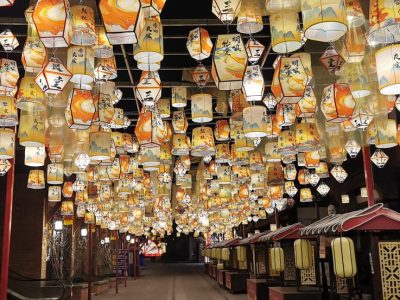
Chinese Poetry Lantern Corridor — Calligraphy & Ink-Painting Hexagonal Lanterns
View Details →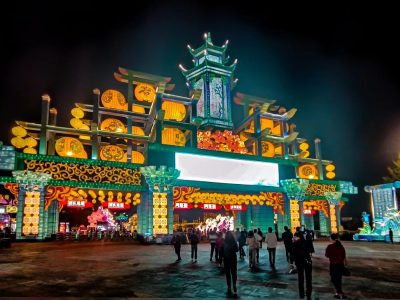
Giant & Large-Scale Lanterns
Lantern Archway Gateway — Chinese Palace-Style Lantern Gate
View Details →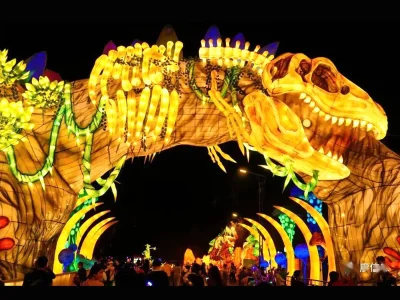
Giant & Large-Scale Lanterns
Dinosaur Fossil Archway Lantern — Prehistoric Skeleton Entrance Gate for Dino Parks
View Details →
Giant & Large-Scale Lanterns
Walk-Through Lantern Tunnel — Immersive Corridor Lantern Display for Festivals, Theme Parks & Zoo Lights
View Details →Questions
Frequently Asked Questions
Interested in This Product?
Get a custom quote within 24 hours. Our team is ready to help.