Chinese Dragon Lantern & Dragon Dance Festival Display

Chinese Dragon Lantern & Dragon Dance Festival Display
Two traditions, one centrepiece. This display merges the dragon lantern (龙灯) — the monumental illuminated dragon figure that anchors the Chinese Lantern Festival — and the dragon dance (舞龙) — the living performance where teams of dancers bring a dragon…
Two traditions, one centrepiece. This display merges the dragon lantern (龙灯) — the monumental illuminated dragon figure that anchors the Chinese Lantern Festival — and the dragon dance (舞龙) — the living performance where teams of dancers bring a dragon to life through coordinated movement — into a single, dramatic festival centrepiece.
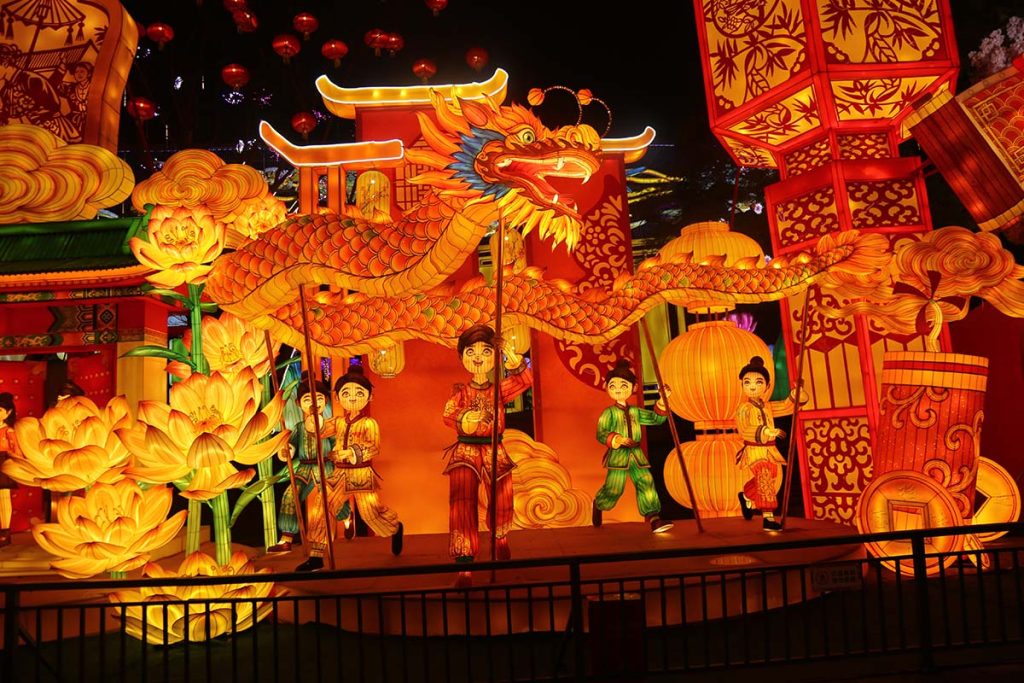
The centrepiece is a towering golden dragon suspended in mid-air, its body curving through the scene as if mid-dance. Below the dragon, traditional dragon dance performers — warriors in red, green, and gold robes holding ceremonial poles and weapons — stand in formation around the dragon, recreating the energy and pageantry of a live dragon dance performance, now frozen in illuminated silk at monumental scale. A classical Chinese palace backdrop with red pillars and lotus flowers frames the entire scene, grounding the display in traditional architecture.
Hanging a Dragon Across Ten Metres
A dragon body curving through the air is the most demanding shape we build. It has no flat planes, no straight edges, and its weight never sits over its own base. The largest chinese dragon lanterns in a festival are always the ones hung rather than stood, and the rigging plan is what decides whether they work.
On a ten-metre span the body splits into five to seven sections, each with its own rigging point. Head and tail carry counterweights because they sit furthest from support, and the section joints land where the body already narrows so the break is not visible from below.
The curve is what makes or breaks it. Dragon bodies get described as serpentine, but in practice two shapes work: a shallow S with three bends, or a rising spiral where the head climbs and the tail trails low. More bends than that and it reads as a caterpillar at distance.
Where the body hangs free, it moves. Even indoors an air-handling system sets a ten-metre dragon swaying a few centimetres, and the tail amplifies it. Rigging is specified for that movement rather than as a static load, and the lowest point of the tail stays at least 600 mm above head height.
Composing the Performers Under It
The figures below the dragon do more work than they appear to. They give the piece scale: without them, a dragon could be three metres or thirty and nobody could tell. Two to six performers is the working range, and the number follows the span at roughly one figure per two to three metres of dragon width.
Poses matter more than faces. Poles raised, bodies turned, robes caught mid-swing. A row of figures standing straight with poles vertical reads as a fence. The same figures at three different lean angles and two different heights read as a moment.
Proportion runs slightly heroic. Performers at 1.9 to 2.1 metres beside a ten-metre dragon keep the scene readable from twenty metres without letting the human figures disappear.
Twenty-Five Circuits and a Gold Gradient
Gold is not one colour on a lit surface. The dragon reads as gold because four or five tones are doing different jobs: deep amber on the shadowed underside, brighter gold on the flanks, a pale highlight along the spine where the light hits hardest. Painted in a single tone, the body flattens into yellow plastic.
That is where the circuit count comes from. Twenty-five independent DMX channels let the body be graded along its length instead of lit as one object: head brighter than the middle, tail dimmer, spine picked out separately from the belly. A slow chase along the spine is what makes a static dragon look like it is breathing, and it costs nothing beyond the channel count.
Jaw and eyes want their own circuits, always. On a piece this size, animating the head is the single change that turns a display into a photo stop, and it is usually the detail that gets a chinese lantern display onto a festival poster.
Why combine both traditions in one display? Because for international audiences, the dragon lantern and the dragon dance are often experienced as one — the glowing dragon in the festival sky, the dancers below. By presenting them together, this display becomes the single most complete visual expression of the dragon’s role in the Chinese Lantern Festival.
Built using traditional Zigong lantern-craft techniques, the display contains 400+ square meters of hand-painted fabric, over 5,000 LED points, and modular metal framing for international shipping. Perfect as a festival entrance centrepiece, Chinatown landmark, or the hero attraction of any Chinese New Year or Mid-Autumn event.
| Spec | Detail |
|---|---|
| Theme | Chinese Dragon Lantern + Dragon Dance (舞龙) with Performers and Palace Backdrop |
| Type | Monumental Festival Centrepiece Lantern |
| Size | 10m–25m width; 6m–15m height (customizable) |
| Material | Weatherproof internal frame + hand-painted fabric |
| Surface Finish | Weatherproof acrylic, metallic gold gradient on dragon, fire-retardant silk coating |
| Lighting | 5,000+ internal LED points, 25+ independent DMX circuits |
| Figures | Golden dragon (animated jaw + body sway optional) + 2–6 dragon dance performers + palace architectural backdrop |
| Performance Element | Dragon dance performers with ceremonial poles, weapons, and flowing robe details |
| Installation | Ground-anchored modular sections; crane-assisted assembly |
| Customization | Dragon colour/size/animation, performer count/poses/costume colours, palace backdrop, lotus count |
| Support | Spare parts kit and technical guidance included |
- Dragon Lantern + Dragon Dance, Together: For the first time, a single display captures both icons of the Chinese Lantern Festival — the illuminated dragon in the sky and the dragon dance performers below — giving international audiences the complete dragon experience.
- Dragon Dance Energy in Permanent Form: The performance figures in mid-pose, the dragon’s curved suspended body, and the flowing robe details freeze the kinetic energy of a live 舞龙 into an illuminated permanent installation.
- Narrative Scene Design: Dragon, dancers, palace, and lotus read as a single story — the dragon dance being performed before the ancestral palace — delivering deeper emotional engagement than standalone figures.
- Full Customizability: Choose the dragon colour (gold, red, green, blue), the performer poses and costume details, the palace architecture, and whether the dragon animates (jaw roar, body sway, breathing LED).
- Precision Zigong Craftsmanship: All surfaces hand-painted by master artisans; silk stretched to 2–3% tension tolerance; each performer’s face and clothing individually detailed.
- Social Media & Press Magnet: The combined dragon + dance composition is statistically the most photographed display type at Chinese lantern festivals, generating 3–5× more tagged social media posts than standalone dragon lanterns.
- Giant Lanterns Collection — Monumental festival centrepieces from 10m to 30m, designed as hero attractions for zoo lights and cultural festivals
- Cultural Heritage Lanterns — Chinese mythology, opera, and classical art lanterns preserving intangible cultural heritage
- Asian vs Chinese Lantern Festival — How cultural framing affects your event branding and visitor expectations
- Custom Illuminated Dragon Lanterns for Festivals & Events — Dragon lantern guide covering symbolism, design options, and installation planning
You May Also Like
Related Products
Questions
Frequently Asked Questions
Interested in This Product?
Get a custom quote within 24 hours. Our team is ready to help.