Genie Lantern — Rising from the Lamp
Genie Lantern — Rising from the Lamp
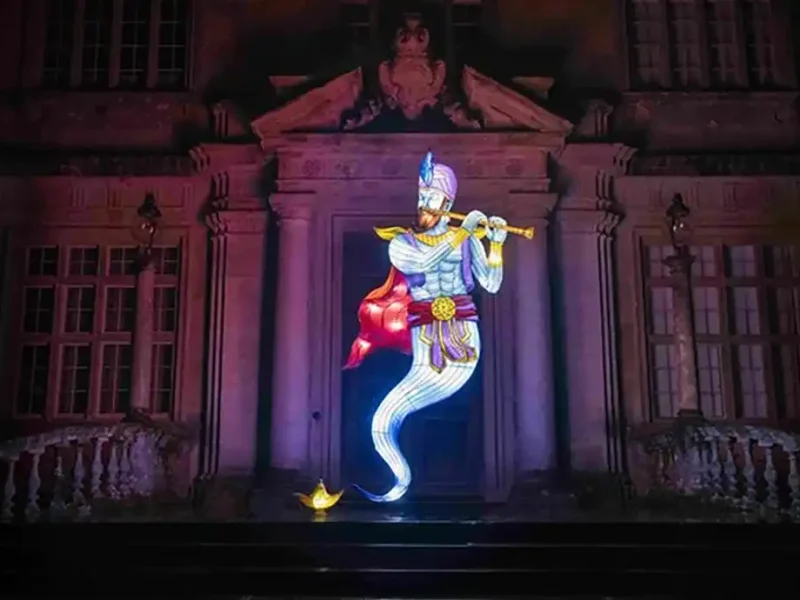
Most lantern figures stand on something. This one comes out of something — a genie rising from a lamp, with the body solid at the shoulders and dissolving into a swirling, weightless tail below. That dissolving lower half is the…
Most lantern figures stand on something. This one comes out of something — a genie rising from a lamp, with the body solid at the shoulders and dissolving into a swirling, weightless tail below. That dissolving lower half is the entire design problem. Everything a lantern figure normally relies on — a compact base, a straight load path, a shape that reads clearly in silhouette from any angle — has to be re-solved, because the part that would carry the weight is the part that has to look like it is not there.
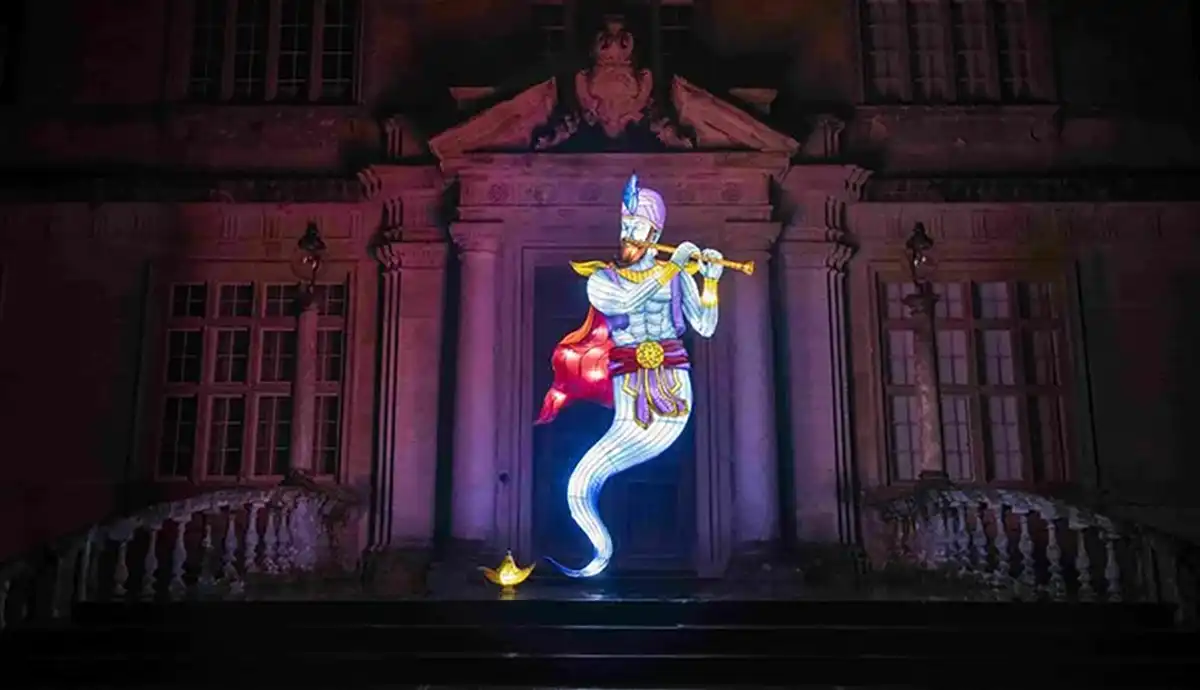
The figure is built on a metal wireframe with a shaped understructure, covered in translucent fabric with hand-finished costume elements — turban, jewellery, cape — and lit internally with a cool blue core and a warm golden accent inside the lamp. Heights run from 3 m to 8 m, with the lamp base between 0.8 m and 2 m across, and the whole piece is rated outdoor-rated as standard with an outdoor-rated upgrade for exposed sites.
The Structural Problem: A Figure That Fades Into Nothing
A floating lower body is a real engineering constraint, not a decorative flourish, and the build handles it in three ways.
- The load goes down through the tail, not around it. The swirling form is a load-bearing shell built around a concealed central spine, so the figure’s weight travels to the lamp base through the shape visitors are meant to read as vapour.
- The tail is anchored, not suspended. Nothing hangs. The swirl connects physically to the lamp platform, which keeps the piece stable in wind and avoids overhead rigging entirely — the single most common reason this kind of design gets rejected by a site engineer.
- Wind load is concentrated where the shape is widest. The broadest part of the swirl and the flowing sleeve and cape elements are the governing surfaces for wind, so bracing is distributed there rather than evenly.
The result is a figure that reads as weightless from three metres away while being, structurally, an ordinary ground-standing piece. If a site can take a standard figure, it can take this one.
Colour and Cultural Fit — Arabian Nights Without the Clichés
The palette does most of the storytelling here: deep blue body, golden accessories, purple turban and a red cape. Three things are worth deciding deliberately.
- Blue is the identity, so it must not drift. A cool blue core can shift towards green or violet depending on the temperature of the light behind the fabric. The body blue is set from a reference under the actual lighting, not chosen from a colour chart in daylight.
- Gold does the framing. The lamp, cuffs, belt and jewellery sit in warm gold, which separates the figure from a dark background and reads as metallic rather than yellow.
- Red and purple are accents, not fields. The cape and turban are small areas. Spread either over a large surface and the figure stops reading as a single character and starts reading as a decorated object.
- Avoid literal costuming. The storytelling appeal of this figure is that it works for family audiences across cultures. The design borrows the silhouette and the palette rather than reproducing a specific production’s costume.
Two light temperatures — cool blue on the body and warm gold in the lamp — is the practical ceiling for a figure this size. Adding a third colour into the mix is the most common reason this kind of piece looks busy at night.
The Lamp as Base, Light Source and Focal Point
The lamp is doing three jobs at once, and it is worth stating them because venues often ask to shrink it.
| Role | What it does | Practical note |
|---|---|---|
| Base | Carries the figure’s weight and provides the fixing points | Diameter runs 0.8–2 m depending on figure height and site |
| Light source | Warm interior glow that reads as the origin of the figure | Zoned separately from the body lighting so it can be dimmed or brightened alone |
| Focal point | Pulls the eye to the bottom of the composition and grounds it | Optional smoke or haze accents around the spout are common at this scale |
Shrinking the lamp to save floor space weakens all three at once: the base becomes marginal for wind, the glow loses its presence, and the figure looks like it is standing on a prop rather than emerging from one. Where the footprint is tight, reduce the figure height instead and keep the lamp proportional.
Scale: Why 3–8 m Works for This Figure
- At 3–4 m, the figure lands at the height where visitors read faces, hands and the flute. This is the version that works in interiors, covered walkways and near photo points.
- At 5–6 m, the composition reads from across a plaza and the tail can be given more turns without looking fussy.
- At 7–8 m, it becomes an entrance landmark, and the flute and smaller costume details stop registering — the silhouette is the whole piece. Only go here if the viewing distance is genuinely long.
One consequence of the floating design: the figure has no feet to stand on, so there is no natural ground-level anchor for the eye. Keeping the lamp large enough to be a real object, rather than a plinth, is what stops the piece from looking like it was cut off at the bottom.
Weather Rating and Site Conditions
The standard build is outdoor-rated, with an outdoor-rated upgrade available for exposed positions. Which one you need is decided by the site, not by preference.
- outdoor-rated standard suits covered positions, atriums, arcades and sheltered courtyards.
- outdoor-rated upgrade is for open plazas, waterfronts and sites with driving rain — worth specifying at design stage, because retrofitting protection after fabrication is far more involved.
- Base fixing is either ballasted for hard surfaces that cannot be drilled, or fixed for permanent outdoor positions. The choice also changes how the lamp reads: a ballasted lamp needs a visible plinth edge, which is why it is resolved at design stage rather than on site.
- should be checked against the site’s equipment, since the figure is tall and thin and is usually serviced from a platform rather than by climbing.
Where This Figure Works
This piece suits Arabian-themed zones, story and fairy-tale attractions, cultural festival programmes, shopping centre atriums and hotel or resort installations — anywhere a single recognisable character needs to hold a space on its own. It sits naturally alongside other narrative figures across a route, and pairs well with pieces that carry a strong silhouette of their own.
For venues assembling a story-themed area, related figures include the ugly duckling display and the flower fairy. For a photo-driven location, the lantern festival photo spot uses a similar single-subject approach. Where a festival programme needs a headline piece rather than a figure, see the radiating canopy centrepiece.
Browse the wider festival lantern range, or the collection of festival lantern design concepts for larger themed environments.
Frequently Asked Questions
Related Products and Designs
Other single-subject figures and narrative pieces: the fortune bag lantern, the festival figure with radiating canopy and the knight with pegasus figure.
For themed environments built around several figures, see themed lantern displays for events and city lantern festival displays.
Send the available height, viewing distance and whether the position is covered or exposed through the contact form, and we will confirm the build rating and base type that suit the site.

You May Also Like
Related Products

Movie & IP Lanterns
Feitian Apsara Lantern — Custom Flying Celestial Maiden Festival Display
View Details →
Questions
Frequently Asked Questions
Interested in This Product?
Get a custom quote within 24 hours. Our team is ready to help.