Arc de Triomphe Lantern — Rainbow Landmark Installation
Arc de Triomphe Lantern — Rainbow Landmark Installation
A landmark replica has one job before any other: it has to be recognised instantly, from a distance, by someone who has never read the label. The Arc de Triomphe is a good subject for a lantern build because its…
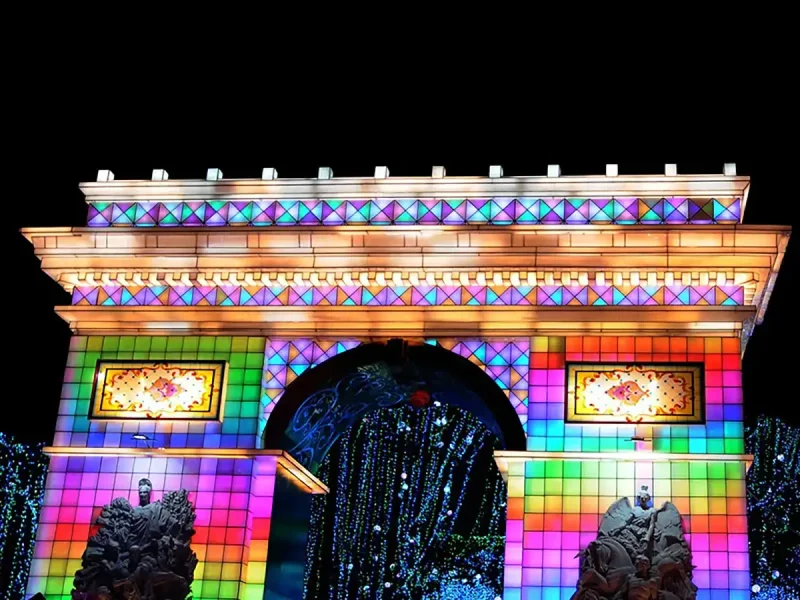
A landmark replica has one job before any other: it has to be recognised instantly, from a distance, by someone who has never read the label. The Arc de Triomphe is a good subject for a lantern build because its shape is unmistakable — the proportions, the single opening and the flanking sculptural groups carry the identity on their own. This version then does something the stone original cannot: the entire facade is built as a full-spectrum light surface, running through purple, blue, green, yellow, orange and red as one continuous gradient.

The structure is a internal frame with a modular panel system, running from about 6 m to 15 m wide and 5 m to 12 m high at proportional scale, with full-spectrum RGB LED lighting capable of rainbow, chasing and static programmes. Classical figure groups flank the arch and the decorative side panels are lit from within to give the stained-glass effect visible in the facade.
A Landmark Replica Has to Be Recognisable Before It Is Decorative
When a building is reproduced as a lantern, three details carry almost all of the recognition. Get them right and the piece reads as the landmark; get them wrong and it reads as “a big arch”.
| Detail | Why it carries the identity |
|---|---|
| The proportion of the opening | The arch reads as a gateway shape, wider than it is tall on the original — changing the ratio turns it into a generic arch |
| The flanking sculptural groups | Solid masses either side of the opening distinguish a triumphal arch from a plain bridge or gate |
| The facade pattern | The grid of decorative panels over the surface is what makes the surface read as carved stone rather than a blank panel |
There is a practical reason for settling these first: they are structural, not painted. The opening size determines the frame’s span. The sculpture groups are separate load-bearing units. The facade grid dictates where panels can be joined, which in turn decides how the lighting can be zoned — and lighting is where a landmark replica usually fails.
The Rainbow Gradient — Keeping One Spectrum Across Many Panels
A continuous rainbow across a surface this large is the hardest part of the build, because the surface is not continuous — it is a grid of panels with seams, and each seam is a place where the gradient can break.
- Never paint the gradient. A painted rainbow locks the colours to fixed locations and cannot change with the event. The gradient is produced by full-spectrum RGB LED behind a neutral diffusing surface, so the same structure can run rainbow, two-colour or a single brand colour.
- Zone the lighting at panel level. Each panel is driven in segments rather than as one unit, so the colour at any point can be set precisely — that is what keeps the transition smooth across a seam.
- Match brightness at the joins. A visible seam is usually a brightness step, not a hue step. Output is balanced across neighbouring segments so the eye reads one continuous surface.
- Neutral diffusion, not coloured film. Coloured diffusion on a low surface limits the achievable range. Neutral diffusion with a controllable source keeps every colour available.
The chase and waterfall effects through the opening use the same principle: the strands are driven in addressable segments, so the cascade speed and direction are set in programming rather than built into the hardware.
The Arch Is a Route, Not Just a Shape
An arch this size will be walked through, whether or not it was intended as a route, and the layout decisions follow from that.
- Clear width. The opening is the certified escape route whenever the piece sits on a formal path. Confirm the required width with the venue before the frame span is fixed, because widening the arch after fabrication is not simple.
- Clear height. The interior of the arch needs enough headroom for the tallest visitor and for anything carried through it — pushchairs, wheelchairs, maintenance equipment.
- Ground finish through the opening. If the route passes under the structure, the ground in that section needs to carry foot traffic safely and should not be a surface that becomes slippery.
- Where the route is not intended. If the arch must not be walked through, a visible low-level planter or barrier is more reliable than a sign, and it should be part of the layout rather than added on site.
The cascade effect through the opening is more than decoration: light falling inside the passage is what draws visitors through it, which is why the effect is programmed to run continuously rather than only on special occasions.
Flanking Sculptures: Weight, Wind and Sightlines
The figure groups either side of the opening are the elements most often underestimated in the build, and they behave quite differently from the arch itself.
- They are the heaviest single units. Each group is a dense mass, and the base or ballast for each is sized on its own rather than shared with the arch frame.
- They are the wind-critical elements at height. The arch is mostly open; the sculptures are solid. Above about 2 m the figure groups govern the wind load of the whole installation.
- They should not block the view through the arch. Masses placed so that they overlap the opening from the main approach direction destroy the silhouette that identifies the landmark. Check the composition from the approach line, not from directly in front.
- Access matters. The sculptures are usually where servicing happens, since they contain the figure lighting. Leave enough clear space behind each group for a person to work.
Scale: 6–15 m Wide and What Changes With It
| Width | Reading | Notes |
|---|---|---|
| 6–8 m | An entrance feature | Works in covered atriums and plazas; the facade detail still registers up close |
| 9–11 m | A plaza centrepiece | The version with the most balanced detail-to-scale ratio; suitable for festival main squares |
| 12–15 m | A landmark viewed from distance | Detail is lost at close range; only worth building where the approach is genuinely long |
Height scales proportionally, which matters for the landmark reading: stretching the arch taller without widening it breaks the proportions that identify the original. Where a site has a height limit, reduce the width as well.
Where a Landmark Replica Works
Landmark replicas suit European-themed zones, city festival squares, cultural festival programmes, exposition entrances and shopping centre atriums — anywhere visitors are already familiar with the building and the recognition itself is part of the appeal. Because the arch is a gateway, it also works as the entry point of a wider route, with the rest of the programme laid out beyond it.
Other architecture-based pieces in the same range: the Eiffel Tower installation, the pagoda lantern and the architectural light sculptures. Where a route begins with an arch of a different shape, see the starlight arch and the walk-through tunnel corridor.
Browse the festival lantern range or see city lantern festival displays for programmes built around landmark pieces.
Frequently Asked Questions
Related Products and Designs
Architecture and gateway pieces: the Eiffel Tower lantern, the pagoda lantern, the architectural light sculpture and the colourful star arch.
See themed lantern displays for events and the festival lantern design concepts for full site programmes.
Send the approach distance, required clear width through the arch and any height restriction through the contact form, and we will confirm the size and base arrangement that fit the site.
You May Also Like
Related Products

Festival Lanterns
Harvest Vegetable Lantern Display — Custom Farm-to-Table Festival Lanterns
View Details →
Festival Lanterns
Mid-Autumn Festival Theme Lantern — Moon Palace Tower Display with Chang’e, Rabbit & Moon Cake
View Details →

Questions
Frequently Asked Questions
Interested in This Product?
Get a custom quote within 24 hours. Our team is ready to help.