Cherry Blossom Lantern Tree Display — Clustered Silk Bloom Canopy
Cherry Blossom Lantern Tree Display — Clustered Silk Bloom Canopy
A cherry blossom lantern tree is built to do one thing that a real tree cannot: hold a canopy of blossom at full bloom for the length of an evening, at a scale people walk under. This build stands roughly…
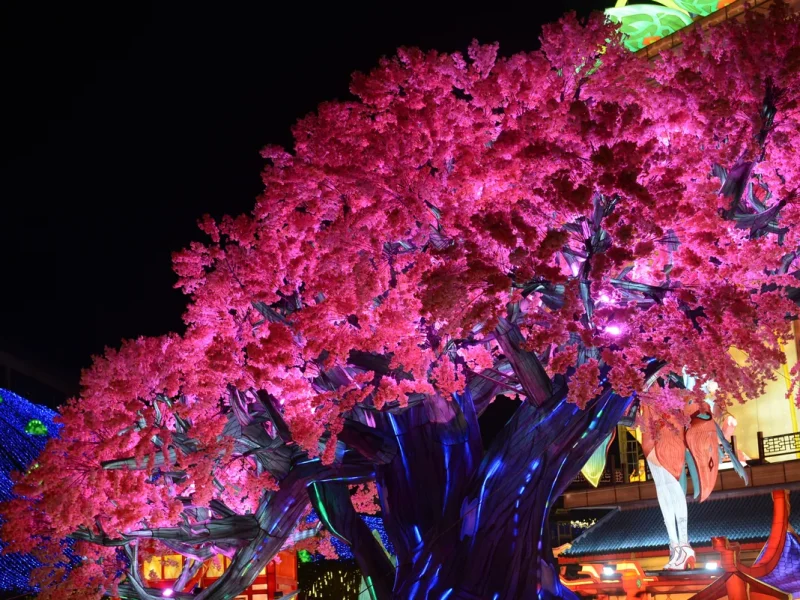
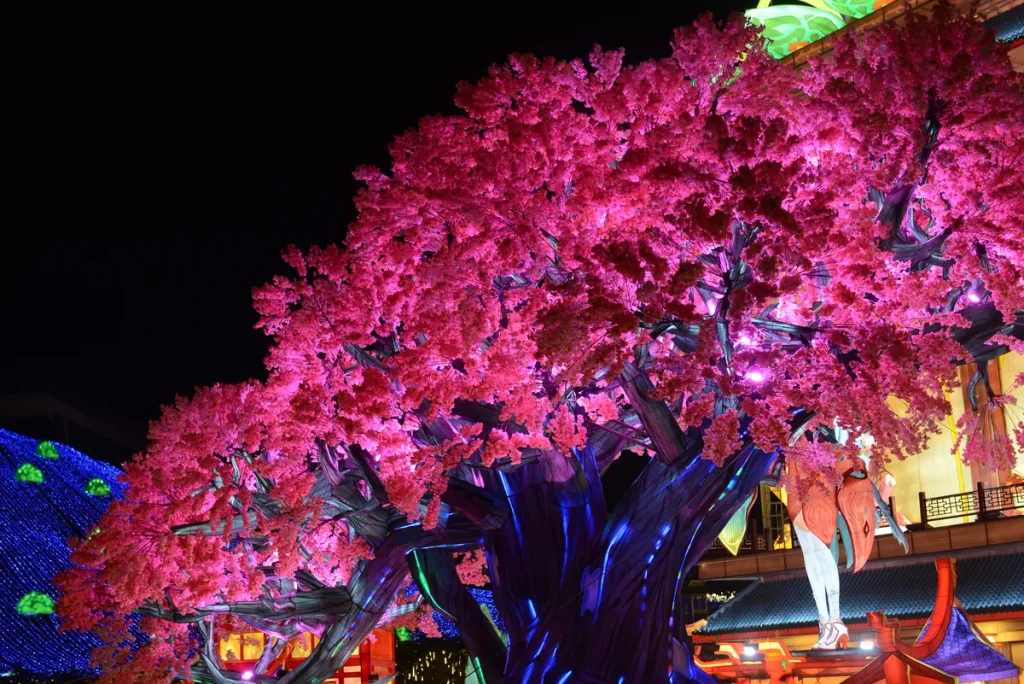
A cherry blossom lantern tree is built to do one thing that a real tree cannot: hold a canopy of blossom at full bloom for the length of an evening, at a scale people walk under. This build stands roughly 6 m to 8 m tall with a trunk of layered sculpted branches that spread into a full crown, and carries several thousand hand-formed blossoms lit from inside so the canopy reads as a solid mass of pink light rather than a wire frame with points on it.
The blossom is the hard part. Real cherry blossom appears in dense clusters on short spurs, and a display that uses large flat petals at even spacing looks artificial within about thirty metres. So the blossoms are formed in small clusters, each cluster positioned to leave visible gaps, with the density increasing toward the interior of the crown where it would be dark anyway. The result has the depth of a real canopy instead of a silhouette.
The tree is usually commissioned as part of a wider composition. Cranes, cranes on lotus, a moon gate or a cloud platform can be placed within the crown or at the base, and a low planting bed with lanterns hides the root plate so the tree appears to grow out of the ground rather than sit on a plinth. When a site needs a focal point that people photograph from all four sides without walking through it, a single mature tree is usually the more effective answer than another corridor.
Sizes run from a compact 3 m to 4 m tree for a plaza or indoor hall, through a standard 6 m to 8 m festival feature, to a 10 m to 12 m hero tree for a main square or a civic plaza. Because the trunk is a structural element, it is calculated for wind in the open position and the base is designed against the ground conditions at the site. Blossom panels are discrete sections on the branch structure, so a damaged area is replaced without rebuilding the tree.
Based in Zigong.
Where This Display Works
Main Squares and Civic Plazas
A single tree gives a plaza a focal point that works from every approach without blocking the space. Civic plazas use it as the meeting point and the photo location, and it carries the event’s visual identity across an open area that has no natural focal structure.
Lakeside and Waterfront Set Pieces
Placed at a water’s edge, a blossom tree reads twice: once in the tree and once in the reflection. That doubling is the reason waterfront sites commission a vertical feature rather than a flat one, because the reflection supplies the scale the tree itself cannot show.
Spring Festival and Cherry Blossom Season Programmes
The tree suits spring programmes where blossom is the visual language, and it works alongside a blossom tunnel or a blossom gate as a repeatable motif across a site. The same tree is also used for spring cultural festivals where blossom carries a specific cultural reference rather than a generic seasonal one.
Malls and Commercial Plazas
An indoor tree at reduced height brings an outdoor seasonal signal into a concourse without a facade change. Malls use it as a campaign centrepiece for a display period, and the crown can be re-lit and re-themed for each season.
Museum and Cultural Venue Atriums
A blossom tree in an atrium gives a vertical subject for a space that is usually all horizontal. It also works as a gathering point beneath it, which gives an atrium a place people choose to stand.
Resorts, Gardens and Heritage Sites
Resorts use it as a seasonal anchor in a garden setting where a real tree would take a long time to establish the same silhouette. Heritage and park sites use it where the planting plan allows a built feature but the root impact of a real specimen tree is not acceptable.
Key Features
Clustered Blossom, Not Flat Petals
Blossoms are formed in dense small clusters on short spurs, positioned with visible gaps and increasing density toward the interior of the crown. This is what separates a tree that reads as a canopy from a wire frame carrying points.
Internal Illumination
Lighting sits inside the crown rather than on the outside of it, so the canopy reads as a solid mass of colour with depth. Internal lighting also keeps the electrical hardware out of the visual silhouette from every viewing angle.
Sculpted Layered Trunk
The trunk and branches are built as a shaped metal structure finished to read as bark, with branches layered so the crown has structural depth. The silhouette is designed from a distance, since a blossom tree is usually seen at range first and close up second.
Root Plate Hidden by Planting
The base is finished with a low planting bed and lanterns so the tree appears to grow out of the ground. Where the site cannot take planting, a sculpted ground treatment closes the base instead.
Composes With Figures and Gates
Cranes, moon gates, cloud platforms and lantern bands can be placed within the crown or at the base, so a single tree can carry a short narrative rather than standing alone.
Modular Blossom Panels
The canopy is assembled from discrete blossom sections on the branch structure. A damaged section is replaced on site, and a spare panel set is worth specifying for a tree in an exposed position.
Weatherproof, UL/CE-Listed Build
Outdoor-rated LED modules and weatherproof construction for continuous display, with UL/CE-listed electrical components throughout.
Specifications
| Product Name | Cherry Blossom Lantern Tree Display |
| Type | Illuminated cherry blossom tree light sculpture |
| Typical Height | 3-4 m compact; 6-8 m standard; 10-12 m hero |
| Crown Spread | Approximately 70-90% of height; set by design |
| Blossom Type | Hand-formed clusters on short spurs; density graded toward the interior |
| Trunk and Branches | Shaped metal structure finished to read as bark |
| Lighting | Outdoor-rated LED modules with internal crown illumination |
| Control | DMX512 for colour, twinkle and fade sequences |
| Base | Metal base plate concealed by a planted bed or sculpted ground treatment |
| Power | 110/220 V AC; distribution designed against total load |
| Weatherproofing | Outdoor-rated build for continuous night display |
| Electrical Components | UL/CE listed |
| Structural Design | Wind load calculated for the site; base designed per ground conditions |
| Installation | Base preparation and assembly on site; crew provided or supervised |
| Customisation | Height, crown spread, blossom colour range, figure set, lighting programme, base treatment |
| Documentation | CE documentation, electrical test records and wind load calculations supplied with the shipment |
| Support | Spare parts kit and technical guidance included |
FAQ
How tall should a cherry blossom lantern tree be?
A 3 m to 4 m tree suits a plaza or an indoor hall and reads well from close range. The standard festival feature is 6 m to 8 m, which is tall enough that the canopy sits above head height and the tree works as a landmark. A 10 m to 12 m hero tree is built for a main square or a civic plaza where the tree has to be visible across the site. The right size follows from the viewing distance rather than from the available footprint.
How do you make the blossoms look real?
Real cherry blossom grows in dense clusters on short spurs, with visible gaps between them. Large flat petals at even spacing are what make a display look artificial, so the blossoms are formed in small clusters and positioned with gaps, with density increasing toward the interior of the crown where the light would not reach anyway. The canopy then has depth instead of reading as a silhouette.
Can cranes or other figures be built into the tree?
Yes. Cranes, cranes on lotus, a moon gate or a cloud platform can be placed within the crown or at the base, and the branch structure is designed around them rather than fitted afterwards. If the site wants a single tree as the focal point, it can also stand alone, in which case the crown is designed to be photographed from all four sides.
Is the tree safe in an open square?
Yes. The trunk is a structural element, so wind loading is calculated for the site and the base is designed against the actual ground conditions. The build is specified as a structure that stands in an open position for a season, and the technical documentation is part of the delivered package.
Can it be used indoors?
Yes, usually at the compact 3 m to 4 m size with a simplified canopy. Indoor versions are set against the ceiling void and floor loading, and internal lighting means no exterior fittings are required. Indoor trees are also often built in sections sized to the available access route rather than assembled on site from large components.
How long does installation take?
A compact indoor tree takes about two to four days. A standard 6 m to 8 m outdoor feature with a prepared base normally runs about a week including assembly, the planting bed and commissioning. We supply layout and structural drawings and can send a crew or work with a supervised local team.
- Plum blossom branch lantern with birds — smaller blossom build for a narrower footprint
- Giant Japanese koinobori fish lantern — seasonal companion piece for the same spring programme
- Flower fairy lantern — botanical garden display with a figure placed at the base
- Sunflower lantern botanical display — single-species floral build for garden settings
- Girl in flowers festival centrepiece — vertical centrepiece for the same plaza
- Festival projects — built tree installations and site photographs
- Request a design and quote — send your plaza dimensions and viewing distances

You May Also Like
Related Products


Questions
Frequently Asked Questions
Interested in This Product?
Get a custom quote within 24 hours. Our team is ready to help.