Sunflower Lantern — Giant Botanical Garden Display

Sunflower Lantern — Giant Botanical Garden Display
A sunflower lantern is one of the few pieces in this range that is sold two different ways at once. You can buy a single giant bloom as a garden centrepiece, or you can buy a field — ten, forty,…
A sunflower lantern is one of the few pieces in this range that is sold two different ways at once. You can buy a single giant bloom as a garden centrepiece, or you can buy a field — ten, forty, a hundred blooms at graduated heights and different stages of opening, arranged to read as a crop rather than a collection of flowers. The two products need different things from the design, and this page covers both: the bloom itself, and how a field of them is laid out so it looks grown rather than installed.
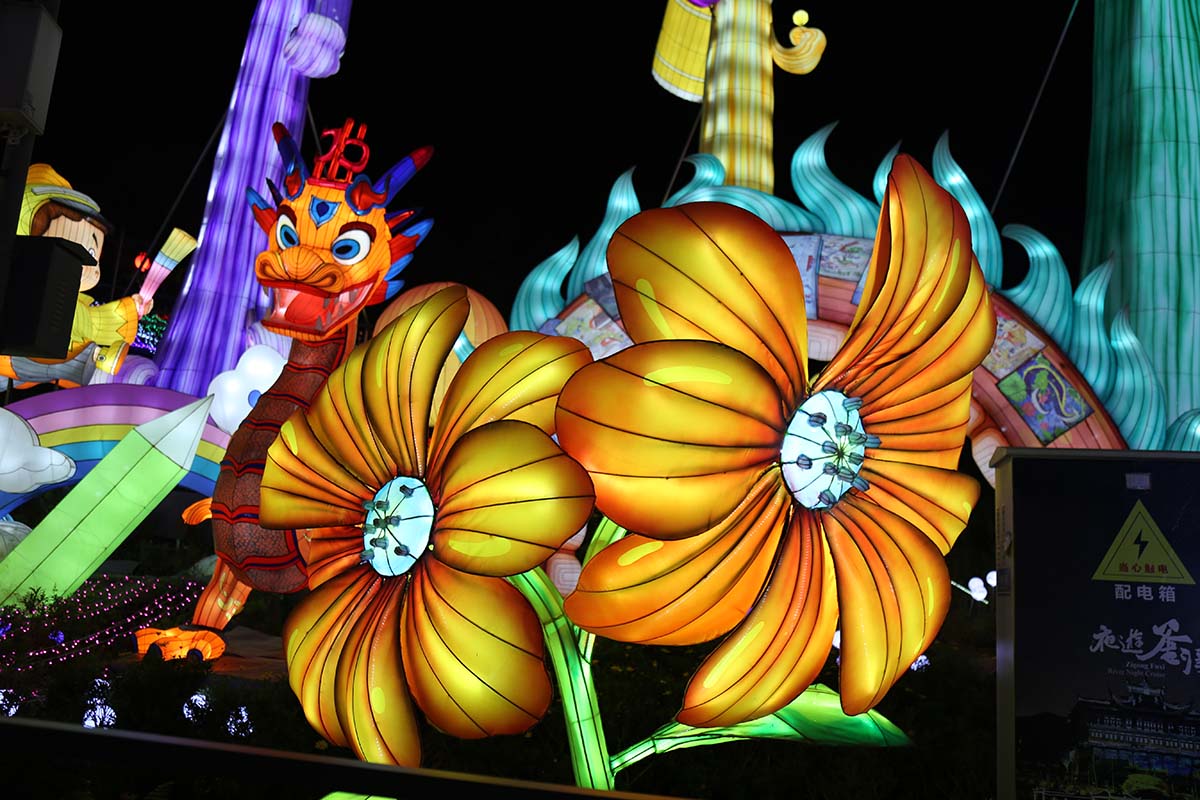
Each bloom is built on a weatherproof metal armature with individually tensioned high-density fabric petals, hand-painted in a gold-to-amber gradient with UV-resistant treatment, mounted on a shaped green stem with layered leaves and a reinforced base plate. Lighting is integrated warm LED in the 2700–3000 K range with an outdoor-rated finish, and wind resistance is documented to Force 6. Blooms run from 2 m to 10 m in diameter at the flower head, with a standard size of 3.5 m.
Two Products in One: a Single Bloom or a Field
Buyers usually arrive wanting “a sunflower” and then discover the decision is really about scale of composition. The two versions are genuinely different products.
| Single bloom | Sunflower field | |
|---|---|---|
| Quantity | 1 (or a small pair) | 10 – 100+ blooms |
| Heights | One stated height | Graduated, typically 1.5 – 5 m |
| Bloom stages | Fully open | Mixed — bud, half-open and full |
| Reading | A feature, seen as an object | An environment, walked through |
| Main risk | Base stability in wind | Looking like rows of identical props |
The single bloom is the easier brief: one object, one viewing distance, one base. The field is where the design work sits, because a field has to survive being seen from inside it — and a field of identical blooms at identical heights is the one thing that instantly reads as artificial.
Why Warm Gold Is the Hardest Colour to Keep Clean at Night
Gold looks simple on a colour chart and is unforgiving in practice. Three things go wrong, and each has a straightforward answer.
- Gold drifts to yellow. A warm gold shifts towards yellow under camera white balance at night. The painted gradient is set from a reference under the final lighting rather than chosen from a swatch in daylight.
- Petals glow unevenly. A petal is a thin, curved surface. If it is lit from a single point inside the head, the tips go dark while the base blows out. The lighting is distributed across the head so each petal reads at the same value from base to tip.
- Gold looks dirty when it loses contrast. Gold only reads as gold while there is variation in it. Flat, even illumination turns it into beige. The amber-to-gold gradient down each petal is what keeps the colour alive at night — and it is the reason the petals are painted rather than cast in a single colour.
- The stem must stay out of the story. Green is the supporting colour here, not a second subject. Keeping the stem and leaves dimmer than the head is what keeps a visitor’s eye on the flower.
The 2700–3000 K range matters for the same reason. That is the colour of late afternoon sunlight, which is what makes an illuminated sunflower read as warm and natural rather than as a yellow light fixture. Cooler temperatures push the flower towards lemon, which reads as artificial immediately.
The Seed Spiral — Where the Detail Actually Lives
The centre disc is the part that separates a convincing sunflower from a flat yellow circle, and it is also the part most often under-designed.
- The spiral has to be sculpted, not printed. The seed pattern is built as a raised surface on the centre dome, so it catches internal light at different angles across its area. A printed pattern shows no change as the visitor moves; a sculpted one changes constantly.
- The dome is domed, not flat. A gently convex centre reads correctly from every direction and gives the petals a direction to radiate from.
- Keep the centre slightly darker than the petals. The contrast between a deep textured centre and bright outer petals is what makes the flower read at distance.
- Detail rewards close viewing. Where the bloom sits at eye height — a 2–3 m head on a low stem — the centre detail is what visitors photograph up close. It belongs in the build itself, not only in the paintwork.
Arranging a Sunflower Field: Height, Stage and Spacing
This is the part no other page in the range covers, and it is what a large order actually depends on. The field principles are simple, and they are the same ones a real crop provides for free.
| Variable | What to vary | Why it works |
|---|---|---|
| Height | Graduated across roughly 1.5–5 m | Creates depth layers; the eye reads a field rather than a fence |
| Bloom stage | Bud, half-open, full | Real crops are never all in flower at once — mixing stages removes the “row of props” look |
| Facing direction | Mostly one way, with a few turned | Real sunflowers track a common direction; a few outliers make it feel alive |
| Spacing | Irregular, denser at the back | Even spacing reads as manufactured; density at the rear adds apparent depth |
| Stem length | Shorter at the front, longer behind | Lets visitors walk at the front edge and still see blooms above head height |
Two practical notes. First, keep a walking edge: a field with a defined front line is easier to route visitors along and easier to protect than one that visitors press straight into. Second, plan the field’s sightline from its own entrance — because the field is walked through, the composition has to work from inside, and the front row is the one that will be photographed most.
Wind Load and the Stem — a Bloom Is a Sail
A 3.5 m flower head is a large flat disc on a narrow stem, which is a wind-load problem by definition. The build addresses it in three ways, and they are worth understanding before choosing sizes for an exposed site.
- The head is the governing surface. Wind load is calculated on the bloom disc, not the stem. Head diameter, not stem height, drives the base and the anchorage.
- Petals are tensioned, not rigid. Individually tensioned silk petals hold their curve and their shape, and they deform rather than tear under load — which also means a damaged petal is replaced individually.
- The base plate is reinforced for the head size. Ground mounting is on a metal stem with a reinforced base plate sized to the bloom. Above a certain diameter on an exposed site, the base treatment changes from ground fixing to a ballasted arrangement.
- Force 6 is documented, not assumed. The rating is stated per configuration, so a site with higher exposure can be specified with a different base rather than discovering the limit on installation day.
The same logic applies in a field: blooms at the exposed edge of a field take a different load from blooms in the middle, so the layout drawing positions the largest heads where they are most sheltered.
Where a Sunflower Display Works
- Botanical gardens and flower shows — the single bloom as a specimen feature, or a field as a seasonal walking exhibit.
- Theme park flower or summer zones — fields read well as a route rather than a single stopping point.
- Summer festivals and city programmes — the bloom works as a photo subject, and the field works as a landmark.
- Hotel, resort and wedding venues — a single head at human scale suits interiors and terraces, where the warm spectrum is chosen to sit alongside existing lighting.
- Farm park and agricultural visitor attractions — the crop reference is understood immediately by the audience.
Related pieces in the same botanical and floral language: the flower fairy installation and the plum blossom branch with birds. Where a garden route needs a structure rather than a flower, see the fairy forest arch and the colourful star arch. For a photo-focused stop, the lantern festival photo spot uses the same single-subject approach.
See the full festival lantern range, the festival lantern design concepts, or zoo lights programming for garden and venue routes.
Frequently Asked Questions
Related Products and Designs
Floral and botanical pieces: the flower fairy and the plum blossom branch.
Structures that carry a garden route: the fairy forest arch, the pagoda lantern, the architectural light sculpture and the walk-through corridor.
Send the garden layout, bloom quantity and whether the display is a single feature or a walking field through the contact form, and we will return a field design with heights and stages resolved.
You May Also Like
Related Products

Questions
Frequently Asked Questions
Interested in This Product?
Get a custom quote within 24 hours. Our team is ready to help.