Plum Blossom Lantern — Branch with Birds

Plum Blossom Lantern — Branch with Birds
A plum blossom lantern is usually bought as a single branch rather than as a scene, and that changes what the piece has to do. There is no figure to carry the interest and no backdrop to hide the structure…
A plum blossom lantern is usually bought as a single branch rather than as a scene, and that changes what the piece has to do. There is no figure to carry the interest and no backdrop to hide the structure behind — the branches are the whole composition, and the birds are the punctuation. It is also the one botanical subject where doing less is almost always the right answer: the traditional bird-and-flower treatment depends on gaps, and the most common failure in lantern versions is a branch that has been filled until the gaps are gone.
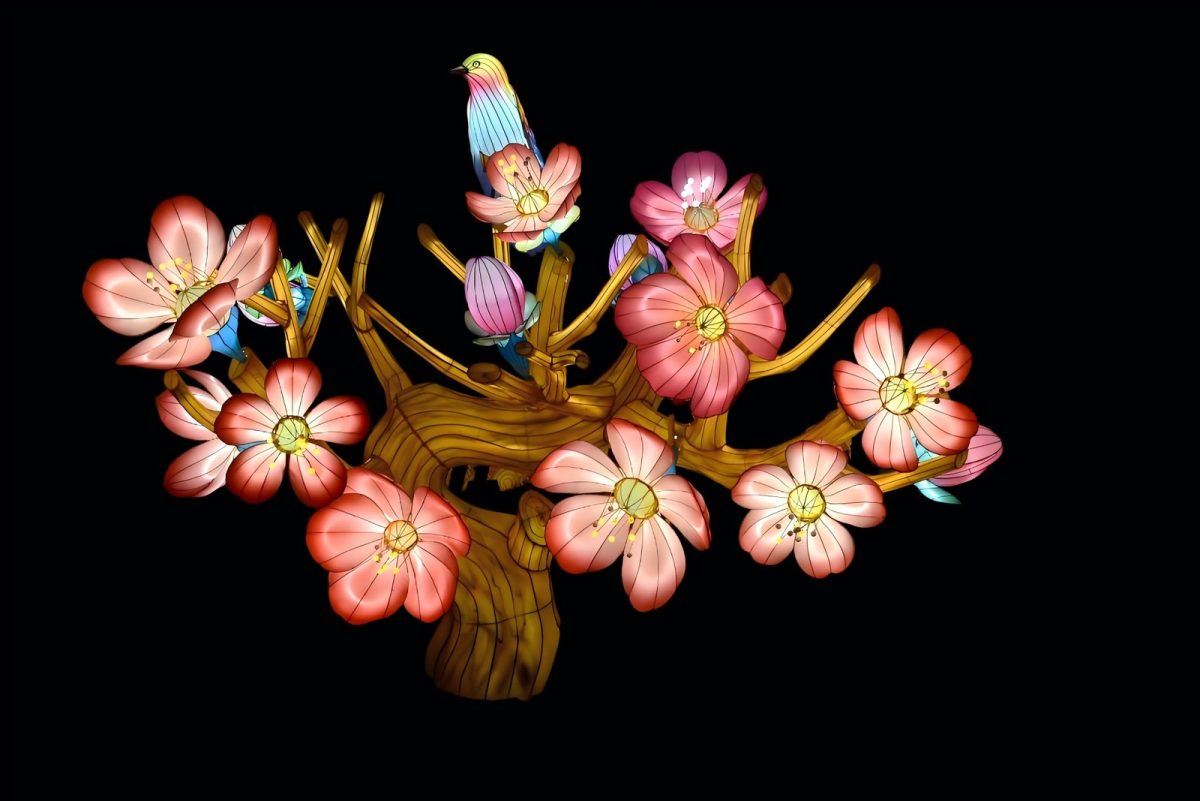
Each branch is hand-bent on a metal armature, wrapped and finished in high-density fabric, with individually formed and painted blossoms and buds. Small bird figures are built as self-contained lit units and mounted on the branch, so they can be positioned to the composition in the workshop and adjusted on site. Lighting runs internally through the branch so that no cable is visible along the outside, and the whole piece is finished for outdoor use with UV-resistant treatment on the painted surfaces.
The branches are the design; the flowers are the finish
Plum blossom pieces fail for a predictable reason: they are designed from the flowers inward. Blossoms are the visible, photogenic part, so more of them feels like more value. But the visual quality of a branch comes almost entirely from the armature underneath — how it turns, where it forks, how far each section travels before it is interrupted.
Three rules that hold on nearly every branch worth building:
- A branch should change direction at least three times along its length. A single smooth sweep is a graphical curve, and a curve reads as decoration. Real plum branches turn abruptly, and it is the abruptness that makes them look grown.
- Forks should not be evenly spaced or evenly angled. Two forks at the same distance from the base produce a hand-drawn Y, which is the fastest way to make a branch look like a prop.
- The branch should not be symmetrical from either approach direction. Since the piece is usually viewed from a path that passes it, an obviously balanced branch reads as complete after two steps.
The practical method is to build the armature first and photograph it bare, then place blossoms against the photograph. Every problem in a plum blossom piece is visible on a bare armature and invisible once the flowers are on.
Keeping pink pink under night lighting
Pink is one of the hardest colours in a night display, and blossom pieces are where it goes wrong most often. Pink is a high-lightness, low-saturation colour, which means it has very little room to lose before it becomes plain white. Under a neutral or cool source it goes first pale, then chalky, and the branch ends up looking like a white branch with grey marks.
What actually works:
- Use warm white at the low end of the range rather than neutral white. A warm source holds the pink saturation. A cool or neutral source drains it, and no amount of extra pigment in the paint compensates, because the problem is in the light rather than the surface.
- Paint each blossom with a gradient, not a flat pink. Real plum petals shift from a paler edge to a deeper base. Painting that shift means that even when the light flattens the surface, some part of the petal is still saturated, and the blossom keeps its colour from a distance.
- Keep the fully open blossoms slightly deeper in tone than the buds. Buds are the palest part of a real branch, and painting them lighter as well as making them smaller gives the branch a natural echo at distance.
- Do not light the branch from one end. Light entering at a single point makes the far blossoms dimmer and colder, which reads as a branch dying off. Distributing the runs so that luminance is roughly even from base to tip is the single biggest improvement available, and it is also the most commonly skipped step.
The same logic applies to the branch and stem colour. A stem painted bright green under warm light goes yellow and imports a colour that does not belong to the subject. Plum wood is a dark, slightly warm grey-brown, and keeping it dark also makes each blossom sit against a firm background instead of floating on a bright branch.
The structure inside a long thin branch
A 2 to 5 m branch of this type is a cantilever with wind load on it, and the honest description of the engineering is that the slender look is only possible because the reinforcement is hidden inside. The visible elements — the branch line, the blossoms, the small birds — take up very little of the load path, so the weight is carried inside the armature.
- The load path runs inside the branch, not around it. Reinforcing a branch externally with stays or brackets destroys the silhouette that makes the piece worth buying. The correct solution is a heavier internal core, graduated along the length, with the outer wrap hiding it.
- Blossoms and birds are weight, and weight at the tip is expensive. Load at the far end of a cantilever multiplies along the branch. On long pieces the technique that solves this is tapering — fewer, smaller and lighter elements toward the tip, which happens to match how a real branch thins.
- Build branch sections as separable units. Long pieces are transported and installed in parts with joints set at natural fork points, where the joint can be concealed inside the structure. Joints on straight runs are visible from every angle.
- Bird units should be independently mounted. A bird that is wired only to the branch section it happens to sit on cannot be moved later. Making each bird a self-contained lit unit that can be re-positioned means the composition can be adjusted on site rather than remade.
One consequence worth planning for: because the piece is usually mounted against a wall, a screen or an interior backdrop, the mounting is often the part that decides whether the whole item is stable. A branch that is stable on a freestanding base may need an entirely different fixing when it is set above head height on a wall, and the fixing has to be decided from the drawing, not on the day.
Placing the birds
The birds are what turn a botanical piece into a scene, and they follow composition rules rather than naturalistic ones. In traditional bird-and-flower work the birds are placed where a viewer’s eye wants to rest, and the placement is always asymmetric.
| Placement | Result |
|---|---|
| Both birds at the top of the branch | Top-heavy, reads as a cartoon, and leaves the lower half of the piece empty and dead. |
| Birds at even intervals along the branch | A pattern. The eye finds the rhythm immediately and the piece stops being read. |
| One bird high on a main branch, one low and closer to the trunk | A composition. Creates a diagonal the eye follows and lets the two birds look at each other. |
| A bird turned to face into the blossoms | A moment. The bird appears to be doing something rather than being mounted. |
Two details that matter more than they sound. First, the birds should not be the same size — a pair at identical scale reads as a repeated unit, and a slight difference makes the larger one read as the subject. Second, at least one bird should overlap blossoms rather than sit in a clear space between them; the overlap is what binds the birds into the branch instead of leaving them as separate objects decorating it.
Density, spacing and the discipline of leaving gaps
The traditional rule for this subject is that a branch should be dense enough in places to be solid and sparse enough in others to be almost bare. In lighting terms this also has a functional purpose: clusters of blossoms catch and diffuse light, and a scattered branch with no clusters has nothing for the light to gather in.
- Work in clusters, not in even distribution. Two or three groups of closely packed blossoms with clear space between them give the branch structure. Even distribution always reads as artificial, no matter how well each individual blossom is made.
- Leave the outer third of the branch sparse. A real branch carries less at the tip, and the sparse end is where the eye reads the movement of the branch line.
- Keep part of the armature exposed. A branch wrapped completely in flowers and silk loses the line that makes it a branch. Bare sections between clusters are what tell the viewer they are looking at a plant rather than a bouquet.
- Keep the flower-to-branch proportion believable at both ends. Blossoms that are too large relative to a thin branch look like paper cutouts; blossoms that are too small disappear at a distance. Building a sample cluster at full size before committing is worth the time on this subject more than on almost any other.
Using a spring subject in a winter programme
Plum blossom is a spring motif, and most lantern festivals run in winter, which is a conflict worth solving deliberately rather than ignoring. Three approaches work:
- Pair it with a seasonal structure rather than placing it alone. A blossom branch inside a lit archway or beside a winter structure reads as an anticipation of spring, which is a legitimate winter theme. The same branch standing by itself on a lawn in December reads as a mistake.
- Put it indoors or under cover. Blossom pieces are more often specified for atriums, receptions, mall interiors and restaurant settings, where the spring reference is welcome all year and the lighting conditions are controlled. This is where most of the demand for the piece actually sits.
- Run it through the Chinese New Year window. Plum blossom carries a specific cultural meaning around endurance and renewal, and it is a standard element in New Year settings — which is a winter season and a natural fit for the subject.
Specifications
| Attribute | Details |
|---|---|
| Branch length | 2 m – 5 m standard, with longer sections built as joined units |
| Structure | Hand-bent metal armature with graduated internal core; high-density fabric wrap |
| Blossoms | Individually formed and painted; gradient petals; separate buds at paler tones |
| Birds | Independent low-voltage lit units, re-positionable on site |
| Lighting | Warm low-end white LED distributed evenly along the branch; no external cable |
| Materials finish | UV-resistant paint treatment on silk surfaces; CE / UL electrical components |
| Weather rating | Outdoor-rated finish; recommended under cover or in sheltered positions on exposed sites |
| Mounting | Freestanding base or wall / backdrop fixing, decided from the site drawing |
| Applications | Spring festivals, cultural exhibitions, garden and botanical displays, mall and atrium installs, Chinese New Year settings |
Frequently Asked Questions
Related Products and Designs
Other botanical and garden pieces: the sunflower lantern, the flower fairy lantern and the fairy forest arch.
Pieces that frame a path or a setting: the pagoda lantern, the star lantern arch and the walk-through corridor. Broader ranges are on the festival lanterns page.
Send the branch length, the intended fixing and the setting — indoors, atrium or outdoor — through the contact form, and we will return an armature design with the blossom distribution and mounting resolved.

You May Also Like
Related Products


Questions
Frequently Asked Questions
Interested in This Product?
Get a custom quote within 24 hours. Our team is ready to help.