Flower Lantern Tunnel Corridor — Walk-Through Silk Floral Build
Flower Lantern Tunnel Corridor — Walk-Through Silk Floral Build
A flower lantern tunnel is the piece that changes how a festival feels from the moment a visitor enters it. The corridor in this build is lined floor to canopy with silk flowers in full bloom: peonies, chrysanthemums, lotus and…
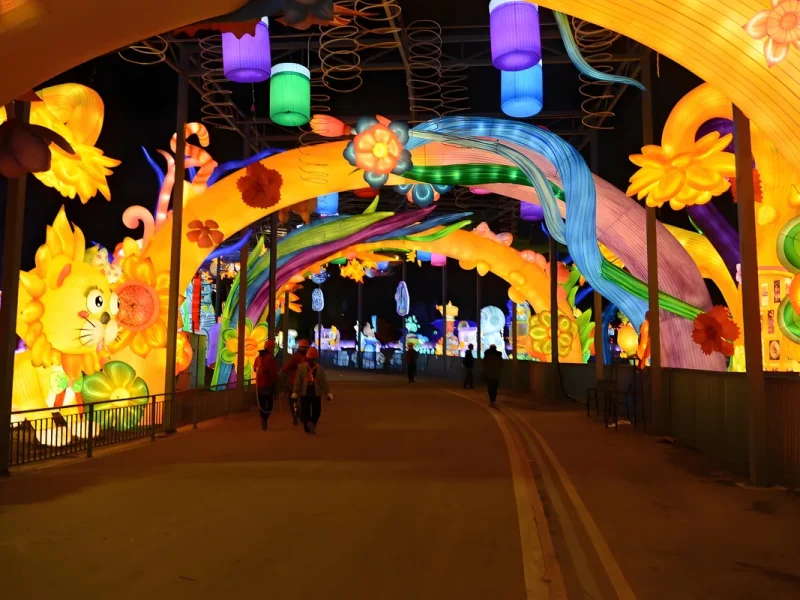
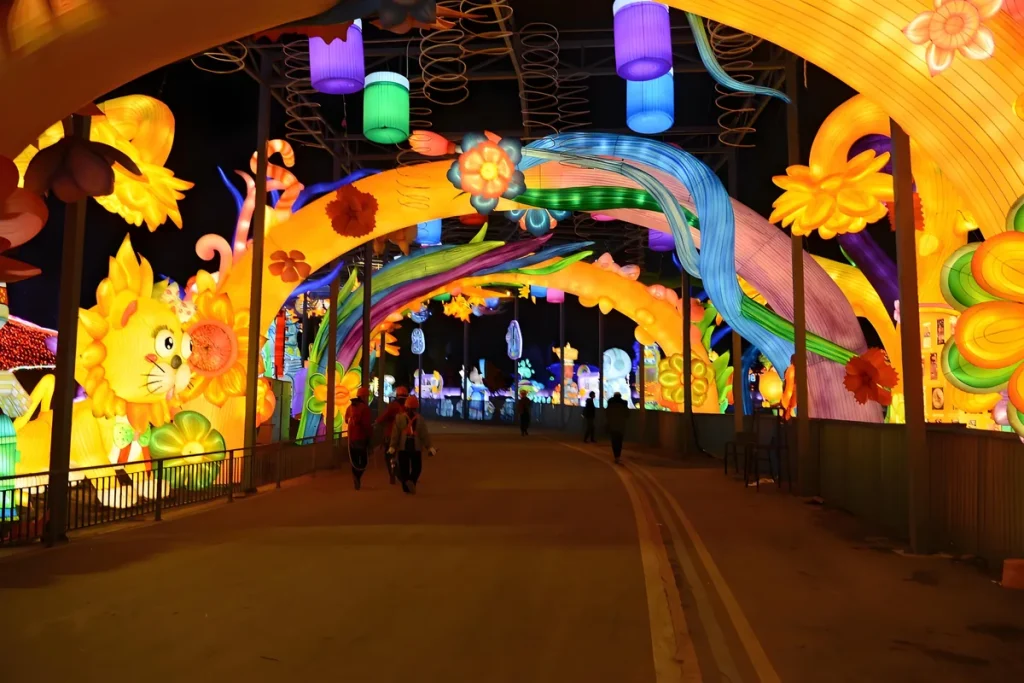
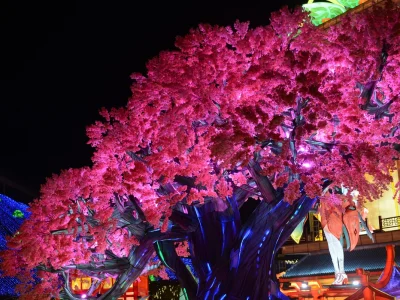
A flower lantern tunnel is the piece that changes how a festival feels from the moment a visitor enters it. The corridor in this build is lined floor to canopy with silk flowers in full bloom: peonies, chrysanthemums, lotus and plum blossom, layered over long fabric swags that sweep across the ceiling in painted colour waves, with clouds, phoenix and peacock figures worked into the composition. The visitor walks into a garden that is lit from inside rather than a tunnel that is lit from above.
That distinction matters for a lantern festival because it is what separates a walk-through from a corridor of structures. In a structural corridor the visitor sees rows of frames passing by. In a flower lantern tunnel the visitor is inside a garden, and the garden is made of light. Photographically it is the difference between a snapshot and an image people post, which is the practical reason festival organisers keep coming back to this form.
Sizes run from a compact 3 m wide passage suited to a plaza or an indoor hall, through a 5 m to 6 m festival main route, to a wide 8 m covered version built for high footfall. Height runs from about 3 m at the crown for a single-span passage to 5 m or more where a walk-through roof structure is added. The canopy is a separate element from the side walls, so a client can extend the length of a route without changing its cross-section, or shorten the covered section and leave the open ends planted instead.
Because it is a linear structure running through a public route, the engineering is part of the design package. Wind loading is calculated for the site, the base is designed against the actual ground conditions, and walkway width, ceiling clearance and cable routing are resolved in the drawings before fabrication. The fabric elements are tensioned over shaped metal subframes and every panel is a replaceable section rather than a single continuous skin.
Based in Zigong.
Where This Display Works
Main Festival Routes
The tunnel gives a lantern festival a defined approach. Visitors move through it slowly, which raises dwell time at the entrance, and the corridor itself becomes the first thing photographed and shared before they reach the main installations.
Botanical Gardens and Park Events
A flower lantern tunnel translates a garden programme into a nighttime one. Botanical gardens use it to extend opening hours into the evening, and park events use it to connect a car park to a ticketed zone without visitors feeling like they are walking through service areas.
Malls and Commercial Plazas
A covered version works as a seasonal atrium installation. It draws footfall from the main concourse, gives a seasonal campaign a walk-through format instead of a static display, and can be re-themed for a new campaign between seasons.
Theme Parks and Cultural Tourism Districts
The tunnel functions as a route connector between zones, so it carries visitors rather than stopping them. It is also a natural place for a small narrative element, because a short sequence of flower panels reads at walking pace.
Indoor Halls and Winter Markets
A compact version works under a roof where the structure is not required. Indoor halls, museum atriums and covered market streets use the corridor to carry a themed passage through a space that has no outdoor lighting provision.
Hotel and Resort Arrival Routes
Resorts use a flower tunnel to carry a seasonal theme from the arrival point into the property. It sets the tone before the guest reaches the lobby and photographs well enough to be used in the property’s own marketing.
Key Features
Dense Silk Floral Coverage
Flowers are layered at multiple depths rather than applied as surface decoration, so the wall reads as a garden with volume. Peony, chrysanthemum, lotus and plum blossom are the standard set, and species can be specified to match a host region.
Canopy Swags and Painted Colour Waves
The ceiling treatment is part of the artwork, not a cover. Long fabric swags in graded colour bands run the length of the corridor, which is what closes the composition overhead and removes the tunnel feeling from a walk-through.
Mythic Figures Worked Into the Composition
Phoenix, peacock and cloud motifs are built into the panel layout rather than placed beside the route. The result is a single scene that reads correctly from any point, which matters when most visitors see only a section of it.
Modular by Length
The corridor is assembled from repeatable bays, so route length can be extended in increments without redesigning the cross-section. A client can add a second covered section the following season and match the original exactly.
Engineered for a Public Route
Wind load is calculated for the site, the base is designed against the ground conditions, and walkway width, ceiling clearance and edge protection are resolved before fabrication. The piece is specified as a route that people walk through, not as a scenic panel.
Replaceable Fabric Sections
Silk is tensioned over shaped metal subframes in discrete panels. A damaged section is unhooked and replaced on site, so the tunnel is repaired in hours rather than closed for the season.
Weatherproof, UL/CE-Listed Build
Outdoor-rated LED modules and weatherproof construction for continuous display, with UL/CE-listed electrical components throughout.
Specifications
| Product Name | Flower Lantern Tunnel Corridor |
| Type | Walk-through floral lantern corridor with fabric canopy |
| Typical Width | 3 m compact; 5-6 m standard; 8 m wide covered version |
| Crown Height | About 3 m single span; 5 m or more with a walk-through roof |
| Route Length | Set by site; modular bays allow extension in stages |
| Floral Species | Peony, chrysanthemum, lotus, plum blossom; other species on request |
| Canopy Treatment | Layered fabric swags in graded colour bands |
| Frame | Weatherproof internal skeleton, sectional construction; wind load calculated per site |
| Skin | Hand-painted high-density fabric over shaped understructure, tensioned in panels |
| LED System | Commercial-grade LED modules with internal illumination |
| Control | DMX512 for accent and colour sequences |
| Power | 110/220 V AC; distribution designed against total load |
| Weatherproofing | outdoor-rated internal lighting; outdoor version designed for continuous operation |
| Electrical Components | UL/CE listed |
| Installation | Ballasted or piled base per ground conditions; crew provided or supervised |
| Customisation | Flower species, colour palette, mythic figure set, canopy wave colours, width, length |
| Documentation | CE documentation, electrical test records and wind load calculations supplied with the shipment |
| Support | Spare parts kit and technical guidance included |
FAQ
How wide does a flower lantern tunnel need to be?
A compact passage runs about 3 m wide and suits a plaza or an indoor hall. Standard festival routes run 5 m to 6 m, which allows two-way movement and gives room for planted edges and lighting. A wide covered version at 8 m is built for high footfall and can carry a raised walkway if the crowd profile requires it. The right width follows from the expected footfall and whether visitors walk through or queue inside.
Can the flower species be matched to our region?
Yes. Peony, chrysanthemum, lotus and plum blossom are the standard set because they read clearly at distance and hold their shape when lit. Other species can be specified, including regional flowers or a client’s own brand palette, and the mix is adjusted to keep visual balance across a long corridor rather than repeating one motif.
Is the canopy included or is it an open-air walkway?
Both are available. The canopy is standard because it is what closes the composition overhead and creates the garden effect, but an open-air version with lighting gantries can be built where the site is sheltered or where the client wants planting along both sides instead. Height and span are set together with the roof decision at design stage.
How is the structure safe for visitors in wind and rain?
The corridor is engineered as a public route. Wind loading is calculated for the site, the base is designed against the actual ground conditions, walkway width and ceiling clearance are resolved in the drawings, and edge protection is specified where the drop to the ground exceeds a safe height. The technical documentation is part of the delivered package.
What happens if a silk panel is damaged?
The silk is tensioned over shaped metal subframes in discrete panels rather than one continuous skin. A damaged section is unhooked and replaced on site, so the repair is a maintenance visit rather than a rebuild. It is worth specifying a spare panel set for a season-long installation where the tunnel is in an exposed position.
How long does installation take?
A compact 3 m passage takes about three to five days. A standard 5 m to 6 m festival route with a covered canopy normally runs one to two weeks including the base, the floral panels and commissioning. We supply layout and structural drawings and can send a crew or work with a supervised local team.
- Lantern corridor walkthrough — simpler structural corridor when the client wants less floral coverage
- Walk-through lantern tunnel — tunnel format built around light structures rather than silk floral panels
- Red lantern pavilion corridor — high-sided corridor build for a route that needs more visual enclosure
- Giant fantasy flower garden lantern — oversized floral installation for the square the tunnel leads into
- Floral arch lantern entrance — floral gateway for the entrance end of the same route
- Festival projects — built programmes, route scale and site photographs
- Request a design and quote — send your route length, width and site plan

You May Also Like
Related Products



Questions
Frequently Asked Questions
Interested in This Product?
Get a custom quote within 24 hours. Our team is ready to help.