Ocean Goddess with Dragon Lantern — Mythical Sea Theme
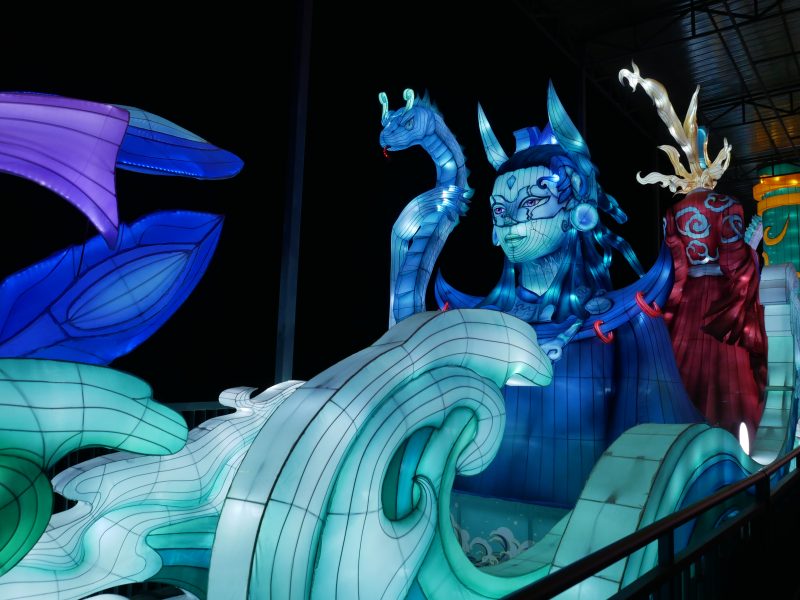
Ocean Goddess with Dragon Lantern — Mythical Sea Theme
Cultural Lanterns A goddess and a dragon in one composition needs a clear hierarchy — two large mythological subjects compete unless one is deliberately placed above or behind the other. Cultural Lanterns·Built to order·Zigong workshop Solving the two-subject problem Mythological…
Cultural Lanterns
A goddess and a dragon in one composition needs a clear hierarchy — two large mythological subjects compete unless one is deliberately placed above or behind the other.
Solving the two-subject problem
Mythological scenes with two strong figures fail when both are given the same visual weight: the viewer's eye has nowhere to land. The solution is hierarchy. In this composition the goddess is the fixed vertical element and the dragon moves around her, so the eye reads the figure first and follows the dragon second. That is a composition decision made before any frame is built.
The dragon's role is also structural in the composition: it frames the figure, closes the silhouette on one side, and gives the piece its horizontal spread without adding a second competing centre.
Why this theme sits between land and water
The ocean goddess theme works on dry ground as well as beside water, which is unusual for a marine subject. The reason is that the reference is mythological rather than naturalistic: visitors read a sea deity and a dragon as a cultural image, not as creatures that have to be near the sea. That makes the piece usable in plazas, forecourts and covered atriums.
Beside water it gains a reflection, which is why waterfront commissions often specify a lower base and a wider footprint.
Figure construction
Large figure work is where a workshop's experience shows. The face, the hands and the drapery are the three areas that fail first at scale: faces because the proportions are unforgiving, hands because they are small relative to the piece, drapery because it has to look like cloth while being a rigid surface. All three are built as shaped structure rather than as surface treatment.
The dragon uses the same frame logic as any large animal form, with the body sections built to allow the coils to be assembled on site in the right sequence.
Placement and lighting
The piece is usually placed at the head of a themed zone or as a water-front feature, and it wants an approach angle rather than a pass-by position. Lighting is set to separate the two subjects: cooler light on the figure, warmer on the dragon, so the hierarchy holds at night as well as in daylight.
Outdoor builds use outdoor-rated modules throughout; covered installations can run a lighter frame.
Specification
| Item | Detail |
|---|---|
| Type | Mythological composition — figure with dragon |
| Configuration | Goddess figure as the vertical element, dragon coiled around |
| Structure | Shaped frame for face, hands and drapery; sectional dragon body |
| Surface | Fabric-covered, worked section by section |
| Lighting | Cool tone on the figure, warm on the dragon |
| Rating | Outdoor-rated as standard; covered installations use a lighter frame |
| Scale | Built to order — hierarchy set by the approach angle |
| Installation | Sectioned for container loading; sequenced assembly on site |
Related
Cultural heritage lanterns
Mythological and heritage figure compositions.
Floating and water lanterns
Forms designed for waterfront and reflective positions.
Request a quote
Send the site and whether the position is beside water.
Commissioning a mythological composition?
Send the reference image and the approach direction. We will reply with the hierarchy and the frame breakdown.
You May Also Like
Related Products
Questions
Frequently Asked Questions
Interested in This Product?
Get a custom quote within 24 hours. Our team is ready to help.