Dragon Bridge Water Lantern Installation – Spectacular Floating Arch Display

Dragon Bridge Water Lantern Installation – Spectacular Floating Arch Display
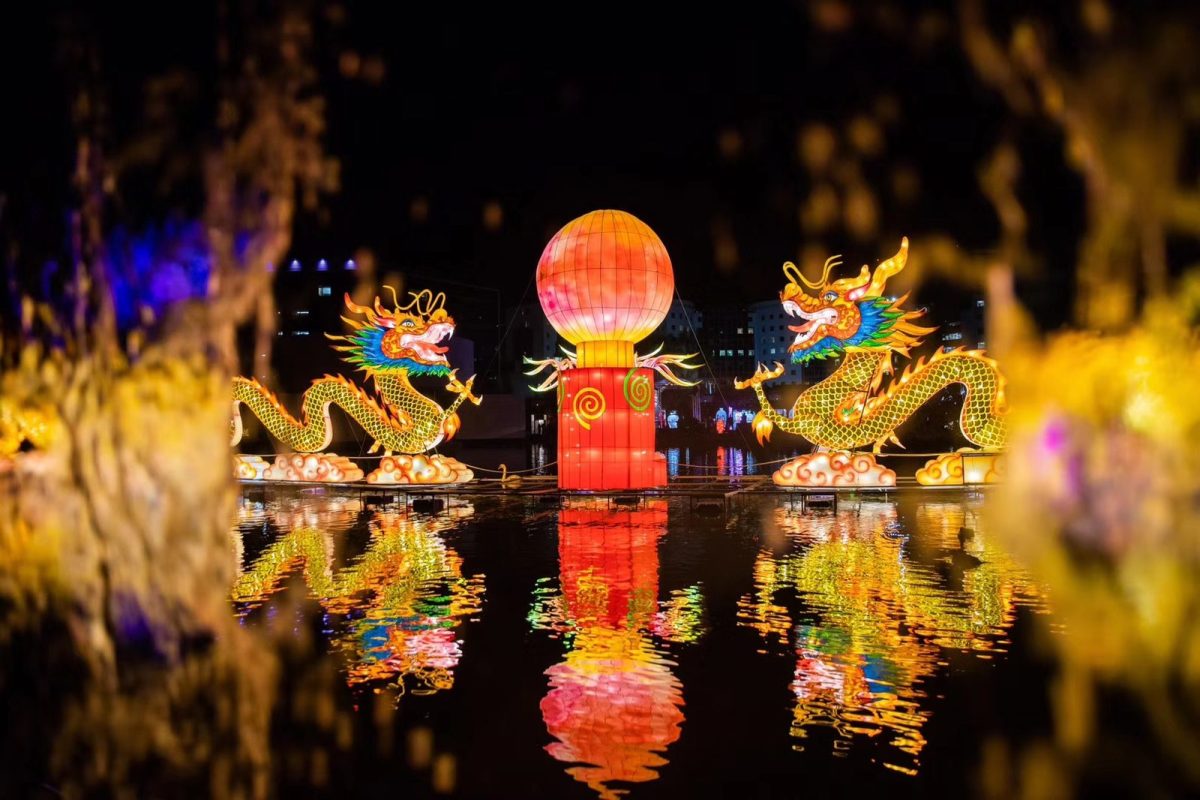
A dragon that crosses water answers a different set of questions from one that stands on land. On this dragon bridge lantern the dragon's body is the bridge: the head rises on one bank, the spine carries across the water, and the tail comes…
A dragon that crosses water answers a different set of questions from one that stands on land. On this dragon bridge lantern the dragon’s body is the bridge: the head rises on one bank, the spine carries across the water, and the tail comes down on the far side, so the whole piece reads as one lit arch instead of a figure placed in a lake. That single decision — span, not float — is what makes the installation suit a channel, a moat or a narrow watercourse rather than an open pond.
It is a piece for sites where water is part of the walking route. Visitors see it from the bank, crews see it from the water, and at night the surface beneath it does half the work: an arch over still water is read as a full circle of light, and the reflection is the reason the installation photographs as well as it does. Red and gold with flame accents along the body, a head that lifts clear of the deck, and a span that can be built to the width of your channel — this is a signature centrepiece for a lantern festival, a waterfront district or a large event ground.
What a Dragon Bridge Lantern Is — and What It Is Not
Three different products on this site are all described as “water dragons”, and they solve different problems. Knowing which one your site needs saves a redesign later:
- A spanned arch (this installation). The dragon forms a structure that crosses the water. It needs two banks or two anchor points, and it gives you a passage underneath plus a bracing line across the view.
- A floating composition. Figures sit on pontoons and drift or moor in open water. The double dragon lake lantern display works this way, with two dragons rising out of a lake in matched poses — the right answer for a wide pond with no far bank to build from.
- A land figure beside water. The giant golden dragon installation is a single sculptural figure for a plaza or an exhibition ground; water may be nearby, but it is not doing structural work.
There is also a pure floating route option — a floating boat water lantern moves along the water rather than spanning it — which pairs well with an arch when you are lighting a long canal in stages.
Spanning the Water — Structure, Anchoring and Water Level
An arch over water is an engineering project before it is a decoration, and most of the design conversation is about the two things water does on its own: it rises and falls, and it moves. The span is set by the channel you have, from roughly 15 m up to 50 m, and the structure is divided into modular sections so it can travel in standard containers and be assembled on site.
| Structure | Arch-shaped dragon body spanning the water, head raised on one side, tail descending on the other |
| Span | 15 m to 50 m, set to the measured width of the channel |
| Materials | Structural internal frame, shaped and covered by hand, marine-grade hardware at the water line |
| Lighting | Programmable DMX LED system, full-colour programmes along the body |
| Protection | outdoor-rated on the structure, IP68 on the light arrays |
| Anchoring | Multi-point anchoring with spring-loaded tensioners that follow flow and level change |
| Installation | 5–10 days with a specialist crew, depending on span and access |
The anchoring is the part worth understanding before you commit to a site. Fixed anchors fail when a river drops a metre or a reservoir is drawn down, so the legs are tied back to multiple points and the tensioners take up the slack as the level moves. That keeps the arch sitting where it was designed to sit rather than following the water down. Where flow is significant, the anchor layout is agreed with the drawings for your watercourse, and structural calculations are issued with the project documentation for permitting.
Water level also decides when you install. Most projects are lifted in during the low-water window, because the deck and the lower leg details are easiest to reach then, and the piece is commissioned before the seasonal water arrives.
Designing the Reflection
On a spanned installation the reflection is not a bonus — it is the second half of the picture, and it is designed for deliberately:
- Keep the near water still. A sheltered channel gives a clean mirrored arch. Where wind chop is unavoidable, we add lit elements low in the composition so there is still a band of light on the surface.
- Light the underside. The span is seen from below as people approach along the bank, so the underside of the body is lit as carefully as the top.
- Colour for the water. Deep reds and golds read strongly in reflection; pale colours wash out. Flame accents along the body give the arch its rhythm.
- Pick the viewing side. One bank is the designed viewing side, with the sightline kept clear; the other side carries the service access.
Clearance and the Route Beneath the Arch
If the arch is going over navigable or usable water, the clear height under the body is the number that matters. It is set against the craft that will pass — festival boats, paddle craft, small tour vessels — and there is a comfortable margin above the tallest one, so boats pass safely rather than carefully. Where the water is not navigable, that height becomes a framing decision instead: enough clearance that the arch still feels like an arch and the water reads as a route rather than a puddle at its feet.
On the banks, the two landings are where visitors gather, so the design includes the ground around each leg — the run of light along the bank, the guard detail where people stand at the edge, and the sightline from the approach path. For venues that light a whole circuit rather than one feature, the arch is usually the point the route opens on, with the rest of the trail planned around it.
Where This Display Works Best
The span format is at its strongest where water already divides a site:
- Canals and urban watercourses — the arch becomes a lit gateway between two banks that were previously separate routes.
- Moat and palace environments — a wide span across still water, framed by the existing architecture, reads as a single statement piece.
- Botanical gardens and lakeside parks — a natural fit where the water feature is the centre of the evening walk.
- Waterfront tourism districts — a seasonal or year-round marker at the point where visitors arrive at the water.
- Festival and event grounds with a water feature — the backdrop for a main stage, a gala or a launch, with the passage beneath kept usable.
If your site has no water at all, the same figure can be built as a land arch, but the design changes and it is worth planning that from the start — the span version is optimised for reflections and for clearance, and neither matters on dry ground. Craft and colour options follow the same approach as our other heritage dragon builds, so a water piece and a land piece on the same site can be made to match.
Frequently Asked Questions
Related Displays and Resources
- Double Dragon Lake Lantern Display — two dragons rising from open water, for sites with a wide pond and no far bank
- Floating Boat Water Lantern — the moving water route that pairs with a spanned arch
- Giant Golden Dragon Installation — the single land-based dragon figure
- Intangible Cultural Heritage Chinese Dragon — the long serpentine land alternative in the same craft tradition
- Chinese Lantern Festival Planning & Sourcing Guide — site, power and programme planning before you brief a build
- Festival Lantern Range — the rest of the water and land installations
Send us the channel width, the normal and flood water levels, the craft that use the water and the access route to the bank, and we will come back with a span layout and a lighting concept for your site. Contact us with drawings or even a phone photo of the crossing — that is usually enough to start.

You May Also Like
Related Products

Floating & Water Lanterns
Floating Boat Water Lantern — Custom Illuminated Festival Lake Display
View Details →
Floating & Water Lanterns
Golden Qilin on Lotus Pond — A Water Lantern with a Living Surface
View Details →
Floating & Water Lanterns
Phoenix & Moon Water Lantern Set – Floating Festival Display
View Details →
Cultural Lanterns
Double Dragon Lake Lantern Display – Traditional Water Festival Decoration
View Details →Questions
Frequently Asked Questions
Interested in This Product?
Get a custom quote within 24 hours. Our team is ready to help.