Knight Lantern Scene — Armoured Group & Winged Dragon
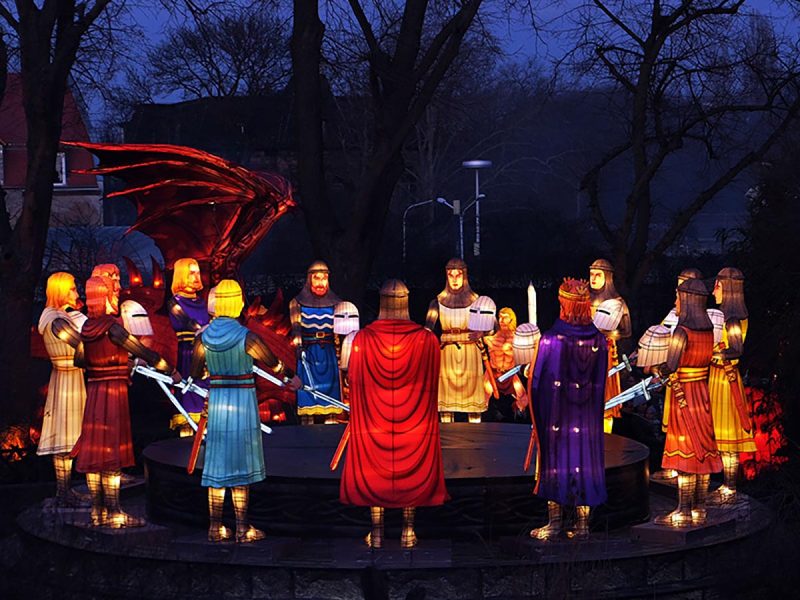
Knight Lantern Scene — Armoured Group & Winged Dragon
A group scene has a problem that a single figure never has: the more characters you add, the less each one is seen. Twelve knights in twelve different armour colours standing in a ring sound impressive on paper and often…
A group scene has a problem that a single figure never has: the more characters you add, the less each one is seen. Twelve knights in twelve different armour colours standing in a ring sound impressive on paper and often collapse on site into a single band of coloured noise. This scene is designed around that specific risk — a fellowship of armoured figures on a circular platform, each individually lit and colour-coded, facing a winged dragon that gives the group its reason to exist.

The knights are built on internal frames with metallic fabrics and detailed armour accessories, running 1.8–3 m each, in groups of eight to twelve. The dragon spans 4–8 m with a 3–6 m body, and the whole scene sits on a circular stone-effect platform 6–12 m in diameter, with individual figure lighting and fire-effect accents on the dragon.
Twelve Figures That Must Not Read as a Crowd
Group scenes fail for predictable reasons, and each one has a design answer.
- Equal height flattens the group. Figures at identical scale read as a row of products. Height variation of roughly 10–15% between figures gives the eye somewhere to travel and makes the group feel like individuals.
- A single ring reads as a fence. Placing every figure at the same radius produces a circle that blocks the view of the dragon behind it. Staggering the radius — some forward, some set back — opens sightlines through the group.
- Poses must differ. Swords raised in identical attitudes look mechanical. Two or three distinct attitudes, repeated in a non-obvious sequence, read as a formed group rather than a copy-paste.
- One figure should read as the lead. A slightly taller or more forward figure, lit a touch brighter, gives the composition a focal point. Groups without a lead look like a crowd.
The practical test is a single photograph from the main approach. If one knight and the dragon are both readable and at least three others are distinguishable, the layout works. If it reads as a wall of colour, it is a layout problem rather than a lighting problem.
Colour Coding a Group So Each Figure Stays Legible
Multiple armour colours — crimson, royal blue, gold, emerald, purple — are a strength and a hazard. The rule that keeps them working is a shared base with individual accents.
| Element | Treatment | Reason |
|---|---|---|
| Base armour | One common metal tone across all figures | Gives the group a single identity and keeps the field calm |
| Tabard, cape, shield | The individual colour, one per figure | The heraldic colour is where variation belongs, and it is a compact area |
| Helm and weapon highlights | Warm accent light | Separates heads from bodies in silhouette across the whole group |
| Shadows and recesses | Left unlit | Darkness between figures is what stops the group reading as one mass |
Two further notes apply at this scale. First, keep the number of distinct colours to about five — beyond that the eye stops separating them and the group becomes a pattern. Second, if the scene will be photographed at night, check the palette in a phone photo rather than on the design board; saturated blues and purples are the two that most often collapse into each other.
The Dragon: Span, Wind and the Biggest Structural Risk
The dragon is the scene’s headline element and also its largest engineering liability, for one reason: a spread wing is a sail.
- Wingspan governs wind load. At 4–8 m, the wings are the largest single surface in the installation. Frame bracing inside the wing structure, and the base connection for the dragon, are sized for the wing rather than for the body.
- Raised wings need a real load path. A wing held above the body carries a bending load at the shoulder joint. This is a designed joint, not a hinge, and it should be serviceable.
- Wings can be built as separate units. Where transport or site access is tight, wings are fabricated as detachable units — which also means a damaged wing is replaced without returning the body.
- Fire effect is lighting, not flame. The fire accents are warm LED through diffusing elements. No open flame is used, which keeps the piece acceptable indoors and in venues with restrictions on effects.
Positioning matters as much as structure. A dragon placed too close behind the knights loses its silhouette against them; set too far back, it stops reading as a threat. The distance between the group and the dragon is the composition, and it is decided with the sightline from the approach.
The Circular Platform and Why It Works
The circular base is not only stage dressing — it solves three practical problems at once.
- It defines the viewing arc. On a round platform, visitors naturally walk around the scene rather than crowding one point, which spreads the load and keeps the queue moving.
- It hides the fixings. All figure bases, cable runs and the dragon’s anchor sit inside the platform, out of sight and out of reach.
- It settles the ground question. A single platform is easier to level and protect than a scattering of individual bases, especially on uneven or planted surfaces.
Because the figures can be repositioned on the platform, the composition is adjustable after delivery — useful where a venue changes its mind about the arrangement, or where the scene is moved to a different site in a later season.
Scale, Sightlines and Staging the Confrontation
- Knights at 1.8–2.2 m read at human height, keeping the scene approachable for family audiences. Above 2.5 m the group starts to feel monumental rather than narrative.
- The dragon should be roughly twice the height of the knights. That ratio produces threat without turning the scene into a horror piece, which matters if young children are part of the audience.
- The platform diameter sets the viewing ring. A 6 m platform suits a courtyard; 10–12 m suits a plaza where visitors will circle the scene.
- Keep a clear standing area on the approach side. Like every group scene, the photograph gets taken from somewhere. If that space is not designed, visitors will create it by standing where they should not.
Where This Scene Works
This piece suits medieval and fantasy-themed zones, castle-style venues, family adventure areas, festival plazas and theme park sections. Because it is a complete narrative tableau, it works as a destination feature rather than an incidental decoration — visitors go to it, rather than passing it.
Related pieces for the same themed area: the knight with pegasus figure, the ancient horse carriage lantern and the game-themed lantern scene. Where a themed route needs an entry, the lion dance gate and the star lantern arch are built to the same scale.
See the festival lantern range, the festival lantern design concepts or themed lantern displays for events for full programmes.
Frequently Asked Questions
Related Products and Designs
Fantasy and narrative group pieces: the knight with pegasus, the game-themed scene and the ugly duckling display.
For gateways and routes that carry the same theme: the lion dance gate and the walk-through corridor.
Send the site dimensions, the number of figures required and the viewing direction through the contact form, and we will return a platform layout with the group positioned.

You May Also Like
Related Products
Cultural Lanterns
Traditional Chinese Architecture Lantern Scene — Pavilion & Auspicious Bird Display
View Details →

Cultural Lanterns
Lantern Corridor Walkthrough — Custom Immersive Festival Light Tunnel
View Details →Questions
Frequently Asked Questions
Interested in This Product?
Get a custom quote within 24 hours. Our team is ready to help.