LED Neon Light Tunnel (Forest & Abstract Light-Outlined Tunnel)
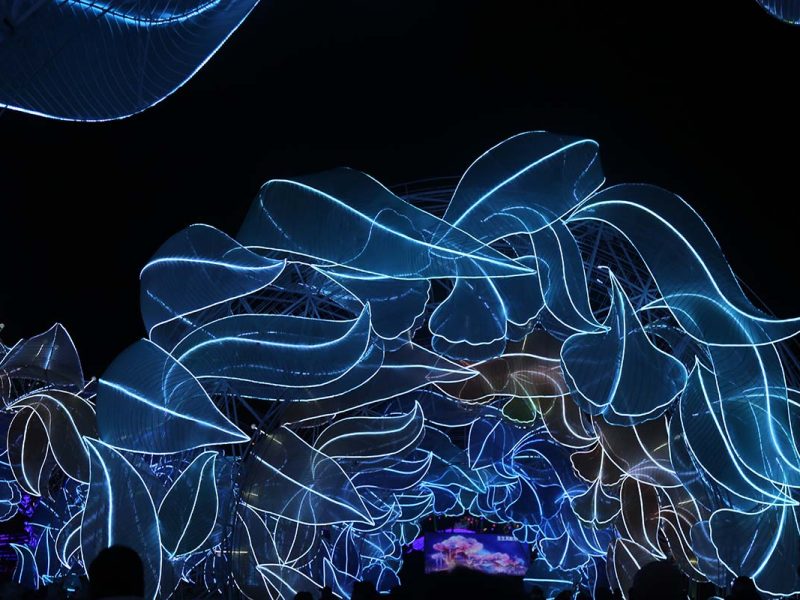
LED Neon Light Tunnel (Forest & Abstract Light-Outlined Tunnel)
Giant & Large-Scale Lanterns An LED neon light tunnel is the one piece on a festival site that visitors walk through rather than past — and the one they photograph most. Giant & Large-Scale Lanterns·Built to order·Zigong workshop A light…
Giant & Large-Scale Lanterns
An LED neon light tunnel is the one piece on a festival site that visitors walk through rather than past — and the one they photograph most.
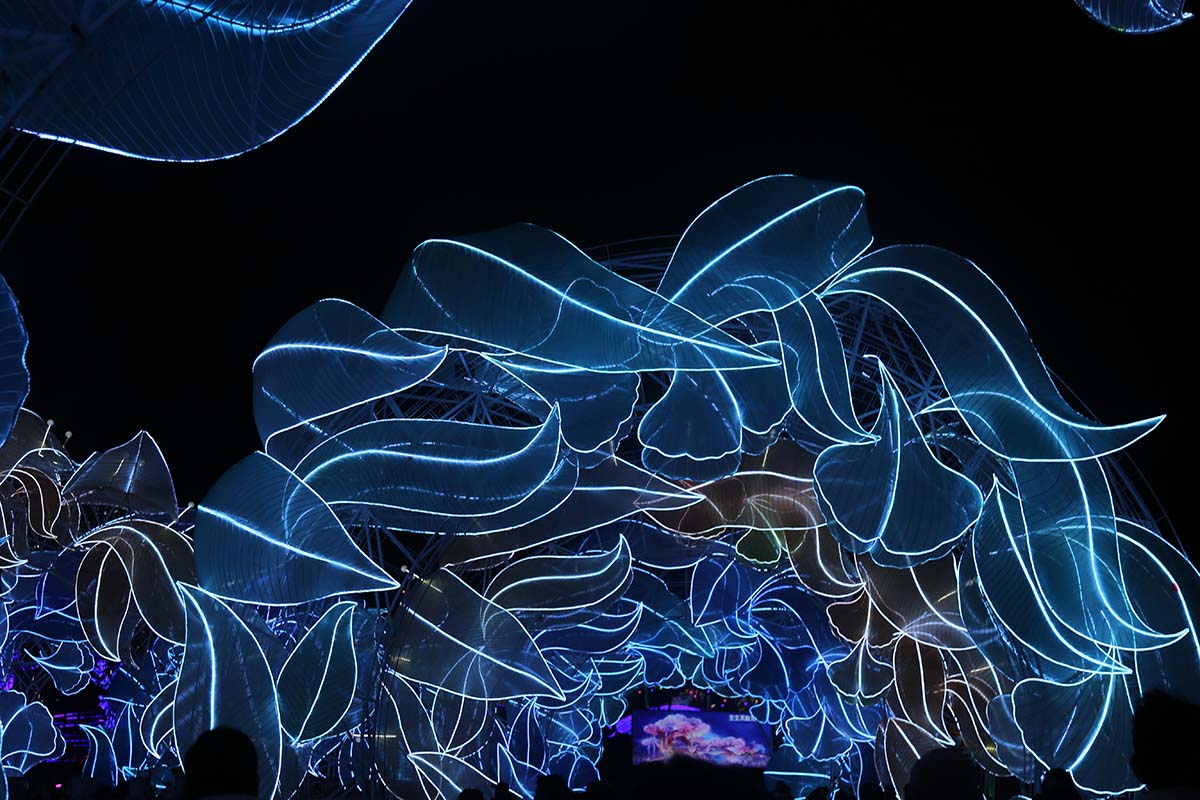
A light tunnel works because of one thing: it puts the visitor inside the display. Every other piece on a trail is viewed from a distance, from a path, from behind a rope. A tunnel removes that distance. For the length of the walk, the visitor is enclosed by the light, and that is what turns a photo stop into a memory.
Why a tunnel changes how long people stay
On a festival trail, dwell time is decided by how many moments visitors stop at. A single large figure gives them one stop. A corridor gives them a sequence: entrance, mid-point, exit, each with a different view. In practice, a well-built tunnel adds two to three minutes of dwell time per group, and it does it without needing more ground area than a straight path already occupies.
That is why tunnels are usually placed at the start of a route rather than at the end. At the entrance they set the expectation for everything behind them; at the exit they are the last thing visitors remember, but they no longer slow people down at the point where the crowds need to keep moving.
Two structural approaches
The frame is the decision that everything else follows from. Our tunnels are built in one of two ways.
Metal arch frame. Welded arches on a fixed span, with the light outline mounted along the arch ribs. This is the version for a semi-permanent position — a park that runs the same trail for several seasons — because it holds its shape and takes wind load without needing a continuous base. The span is a design decision: wider arches need deeper ribs.
Modular panel frame. Sections of 2–3 metres that bolt together on site. This is the version for touring installations, restricted site access, or a venue that wants to change the route length each year. It sections into standard container loads and assembles with a small crew.
What can be outlined
The “neon” in the name refers to the light line, not to neon gas. The outline is built with LED flex mounted on the frame, so the colour and the pattern are both programmable — a forest of branches, an abstract geometric grid, a botanical canopy, or a solid colour field.
A branch-and-foliage tunnel reads as a woodland walk and photographs well in daylight as structure and at night as light. An abstract geometric tunnel reads as an art installation and suits a city centre or a plaza where the surrounding buildings already compete for attention. The choice is usually made from the photograph the venue wants at the end, not from a catalogue.
Siting the tunnel
Three things are settled before the design: the walking width, the clearance height, and the ground surface. Walking width follows the expected crowd — a two-way flow needs roughly 3 metres clear, a one-way guided route needs less. Clearance height is usually set at 2.5 metres minimum so visitors do not duck, and higher where the tunnel is the photograph. The ground surface decides whether the frame needs ballast weights or can be anchored directly.
Where the tunnel sits beside water or on grass, the base design changes before the light design does. That order matters: a tunnel that is beautiful and unstable in wind is a liability on a public site.
Length, Light Line and Control Zones
Tunnel length is set by the route it replaces, not by what looks impressive in a render. The useful range is 15 to 40 metres; shorter than 15 and visitors are through it before the enclosure registers, longer than 40 and the far end stops being visible from the entrance, which is what makes people hesitate at the mouth.
Light line is the number that drives cost. A tunnel of this type carries roughly 8 to 12 metres of LED flex per metre of tunnel length, counting the arches, the longitudinal runs and the detail inside. A 25-metre tunnel therefore uses 200 to 300 metres of flex — useful to know when a supplier quotes a per-metre price that looks low but assumes half the density.
Control is zoned rather than global. A 25-metre tunnel runs four to eight zones along its length, which is what allows a chase to travel down the tunnel or a colour to build from the entrance inward. One zone for the whole tunnel gives a single colour and nothing else, and it is the most common shortcut in a cheap quote.
Density decides how the tunnel reads from outside. At low density the structure is visible through the light and the tunnel reads as a frame wrapped in a line; at high density it becomes a solid glowing tube from a distance. Most festival routes want the second, and it costs more flex — that trade is worth settling before the design is fixed.
What Fails on a Tunnel First
A tunnel takes more wear than any other piece on a site, because every visitor passes through it and touches it.
The flex is the first failure. LED rope mounted on the outside of a frame gets knocked by bags, umbrellas and hands; a run that is surface-mounted rather than set into a channel loses its clips within a season and starts to sag. On a public route, the light line is set into an aluminium channel with a diffuser, not cable-tied to the rib.
Water is the second. A tunnel is a horizontal run of arches, and water collects at every low point where the flex crosses a joint. Connections are the vulnerable part, not the LED itself, and they are the reason a tunnel shows a dead section after heavy rain rather than a slow fade.
The third is movement. On a long span the arches flex in wind, and a rigid light line on a flexing arch works loose at the fixings. Arches above about four metres span carry a deeper rib for that reason, and the light channel is mounted with a slotted fixing so it can move a few millimetres with the frame instead of fighting it.
All three are design decisions, not maintenance problems. A tunnel built with channel-mounted flex, sealed connections at every joint and slotted fixings on the long spans runs a full season without attention; the version built to a lower spec needs a technician on site every week. Where the tunnel is one stop on a longer route, the installation notes in the on-site guide cover sequencing and commissioning.
Specification
| Item | Detail |
|---|---|
| Type | Walk-through light tunnel, LED outline |
| Structure | Welded metal arch frame, or modular bolt-together sections |
| Light line | LED flex outline mounted on frame ribs, colour programmable |
| Walking width | Built to order — set by expected crowd flow |
| Clearance height | Built to order — 2.5 m minimum, higher where photographed |
| Surface | Outdoor-rated LED and enclosures; finish treated for UV and moisture |
| Installation | Sectioned for standard container loading; anchored or ballasted per site |
| Control | Static colour or programmable sequence |
Related
Walk-through lantern tunnel
A corridor built from lantern forms rather than light line — the same route logic, a warmer look.
Giant lanterns
Large-scale structures and how they are engineered for wind load and site access.
Request a quote
Send the walking width, the ground surface and your opening date.
Planning a tunnel for a specific route?
Send the path length, the ground surface and the opening date. We will reply with the span options that fit and what the install window looks like.
You May Also Like
Related Products



Questions
Frequently Asked Questions
Interested in This Product?
Get a custom quote within 24 hours. Our team is ready to help.