Giant & Large-Scale Lanterns Collections
Chinese Lanterns & Festival Displays
Giant Lanterns — Monumental Installations That Define Skylines
Make a statement that cannot be ignored with our giant lanterns and large-scale installations. These monumental sculptures — ranging from 10 to 30+ meters in height — become the iconic landmarks of any lantern festival, the must-see attractions that draw visitors from across regions and dominate social media feeds.
Our large-scale lantern displays combine architectural engineering with artistic vision. Each giant piece is structurally engineered to withstand wind loads, built with reinforced internal frames, and equipped with redundant LED systems for reliable operation. Despite their massive scale, every detail is hand-finished by Zigong master artisans — proof that true craftsmanship has no size limit.
Signature Giant Installations
Dragon Pillars — Towering 20-meter coiled dragons that guard festival entrances
Imperial Gates — Monumental palace arches framing the visitor experience
Palace & Temple Complexes — Multi-structure scenes of imperial grandeur
Mythical Guardians — Fu dogs, qilin, and other protective spirits at scale
Interactive Giants — Motion-sensor animated behemoths that respond to visitors
Ideal for major festival centers, destination events, venues seeking media coverage, and cities wanting signature landmarks. Explore giant lantern possibilities for your venue.
→ Themed Lantern Displays for Events & Venues — read the guide
All Giant & Large-Scale Lanterns
Festival Lanterns
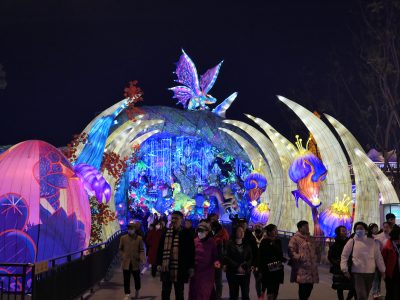
Fantasy Ocean Archway Tunnel Lantern — Elf & Jellyfish Theme
Immersive Fantasy Ocean Archway Tunnel Lantern with jellyfish, seaweed, and elf themes.…

Animal Lanterns
Panda Steampunk Top Hat Lantern
Playful Panda Steampunk Top Hat Lantern with gears, goggles, and mechanical bamboo.…
Giant & Large-Scale Lanterns
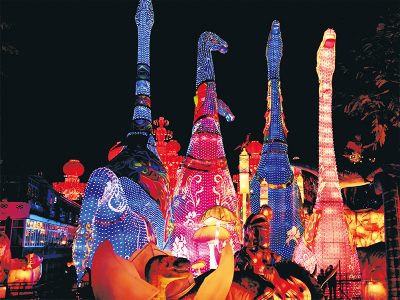
Auspicious Dragon Celebrating New Year
Auspicious Dragon Celebrating New Year — Custom Dragon Lantern Installation Product Overview…
Festival Lanterns
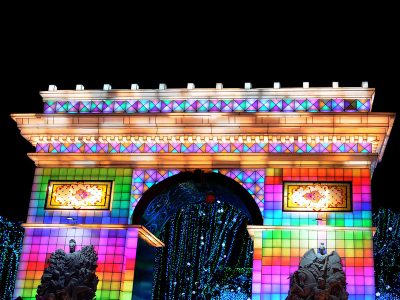
Arc de Triomphe Lantern
Arc de Triomphe Lantern — Rainbow Landmark Installation Product Overview Our Arc…
Giant & Large-Scale Lanterns
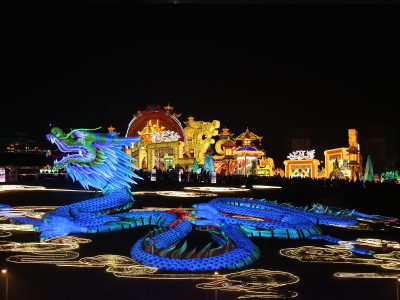
Intangible Cultural Heritage Chinese Dragon
Intangible Cultural Heritage Chinese Dragon — Giant Dragon Lantern Display Product Overview…
- ← Previous
- 1
- 2
Buying Guide
How to Specify a Giant Lantern Installation
A giant lantern is not simply a larger version of a small one. Past a certain size the decisions shift from artwork to engineering — how the piece is broken down for transport, how it is anchored, and how visitors move around and through it. Written for the teams who commission them: city event offices, theme parks, zoos, gardens and show producers.
What Counts as a Giant Lantern?
In practice the line is drawn by how a piece is handled rather than by a fixed number. Up to roughly 3 m, a lantern travels as a single unit, ships on a standard pallet and can be carried by two or three people. Between 4 m and 8 m, it has to be built in sections that lock together on site, and it normally needs a small crane or telehandler to lift. Above 10 m, a piece becomes a structure in its own right: it needs a designed base, a lifting plan and a site survey before production is scheduled.
That is why we treat everything from 4 m upward as a giant lantern installation — it is the point where the project has to be planned as a build rather than ordered as a product. If you are comparing a 3 m figure with a 6 m one, you are not comparing two sizes of the same thing. You are comparing two different kinds of project.
Giant Chinese Lanterns: Scale, Structure and Setting
The giant Chinese lantern is a specific tradition rather than a generic oversized prop. In Zigong, where our workshop sits, lantern makers have been building large illuminated structures for centuries, and the craft carries its own conventions: layered silhouettes that read from a distance, colour that shifts in intensity rather than hue, and an internal frame that lets light travel through the whole body instead of pooling in one spot.
Those conventions exist for a practical reason. A giant lantern is almost always seen from far away first and up close second, so the composition has to work at both distances — a strong outer shape a visitor recognises from across a lake, plus detail that rewards the person who walks up to it. Getting that balance wrong is the most common reason a large piece photographs badly even when the work itself is good.
The setting decides which half of that balance matters more. A piece seen across open water needs a bold, simple outline; one on a narrow city street will be read from a few metres away and can carry far more detail. Send us the site and we will tell you honestly which direction to go — examples of how this plays out are in our notes on large-scale displays.
Large-Scale LED Lantern Displays
At scale, lighting becomes a design problem in its own right. A single giant lantern can carry straightforward internal illumination, but a display of twenty pieces needs a scheme, because the eye reads the group as one composition. We plan colour temperature, brightness levels and the order in which zones switch on so that the installation has a rhythm instead of twenty objects competing for attention.
Programmable control is what lets a large display change character over an evening, or across the run of a festival — a calm warm wash during family hours, saturated colour and movement for a late show. Power draw is planned per zone so individual areas can be shut down for maintenance without darkening the rest of the site. If you are briefing a producer rather than ordering pieces, the same principles apply to a full light sculpture programme.
Archways, Tunnels and Walk-Through Structures
Walk-through structures are the pieces visitors remember, because the light surrounds them instead of facing them. A lantern tunnel or corridor works as a transition between zones and gives a route a natural pause; an illuminated archway marks the threshold of a themed area and does the job of a sign without looking like one.
Designing them is a circulation problem as much as an artistic one. The opening has to clear your widest expected traffic, including wheelchairs, prams and service vehicles, and the structure has to carry its own lighting without throwing glare into visitors' eyes. We size span, height and internal lighting to the venue rather than to a fixed dimension — see the poetry corridor and the dinosaur fossil archway for two very different readings of the same idea.
Engineering, Shipping and Installation
Every giant lantern is designed around the container it will travel in. Large figures are split at natural joints — a neck, a wing, a tail — so that reassembly on site is a matter of bolting and connecting rather than cutting and patching. Each section is labelled against an assembly drawing, and the crate list is keyed to the same numbers, so your team can check a delivery against the drawing in minutes.
Three things need settling early on site: the base, the lifting method and the power route. A piece on soft ground needs spreader plates or a pad; one on hardstanding needs to know what is underneath it. Lifting access decides how heavy any single section is allowed to be. And cabling is the detail that delays installations most often, so we issue a power plan before the truck leaves — the full sequence is in our procurement guide.
Where Giant Lanterns Are Installed
City squares and waterfronts use a small number of very large pieces to create a landmark visible from surrounding streets. Theme parks use them as zone entrances and as the anchor of a night-time route. Zoos and botanical gardens place them at focal points along a trail, where a large silhouette can be read between trees. Shopping centres and hotels commission tall pieces for atriums and entrances, where ceiling height and floor loading matter more than weather.
Each setting rewrites the brief. A waterfront site has to account for wind across open water; a city square has to plan crowd flow and public safety; an atrium piece has to fit through a service door long before anyone admires it. See how this works across a city-wide programme in our city lantern festival displays, or browse themed displays for events.
Giant Lantern FAQs
How tall can a giant lantern be?
There is no fixed ceiling — we have built pieces well past 20 m. What limits height is usually the site rather than the workshop: lifting equipment, access routes, the foundation, and local wind conditions. Send us the location and constraints and we will tell you what is realistic.
Can visitors walk through it?
Yes, and it is often the best use of a large piece. Tunnels, corridors and archways are designed as circulation elements, with opening sizes set to the traffic you expect.
How is a giant lantern shipped?
In sections, flat-packed where possible and crated against an assembly drawing. Everything is sized to standard container dimensions from the design stage, so nothing arrives needing to be cut apart.
Who handles installation?
Either route works. We can send an installation team, or your own contractor can build from our drawings with remote supervision from us. Most overseas projects use their own contractor.
Can a giant lantern be used again next season?
That is the normal plan for pieces built for seasonal use. We supply a dismantling sequence and a storage checklist so the display comes back out the following year instead of being treated as single-use.
Need Design Inspiration?
Browse Our Creative Design Concepts
Visualize your giant & large-scale lanterns project with our AI-assisted concept gallery — see real design directions for festival, holiday, and seasonal events before production.