Mandarin Duck Lantern — Love Bird Pair

Mandarin Duck Lantern — Love Bird Pair
A mandarin duck pair is a subject with an unusual problem: the two birds are not two of the same thing. The male and the female look nothing alike, and the design of the piece depends on that difference being…
A mandarin duck pair is a subject with an unusual problem: the two birds are not two of the same thing. The male and the female look nothing alike, and the design of the piece depends on that difference being visible, deliberate and legible at night. Made as two copies of the same brilliant bird, the piece reads as a duplicated prop. Made correctly, the pair carries the specific meaning the subject is bought for in the first place — two individuals together rather than a repeated motif.
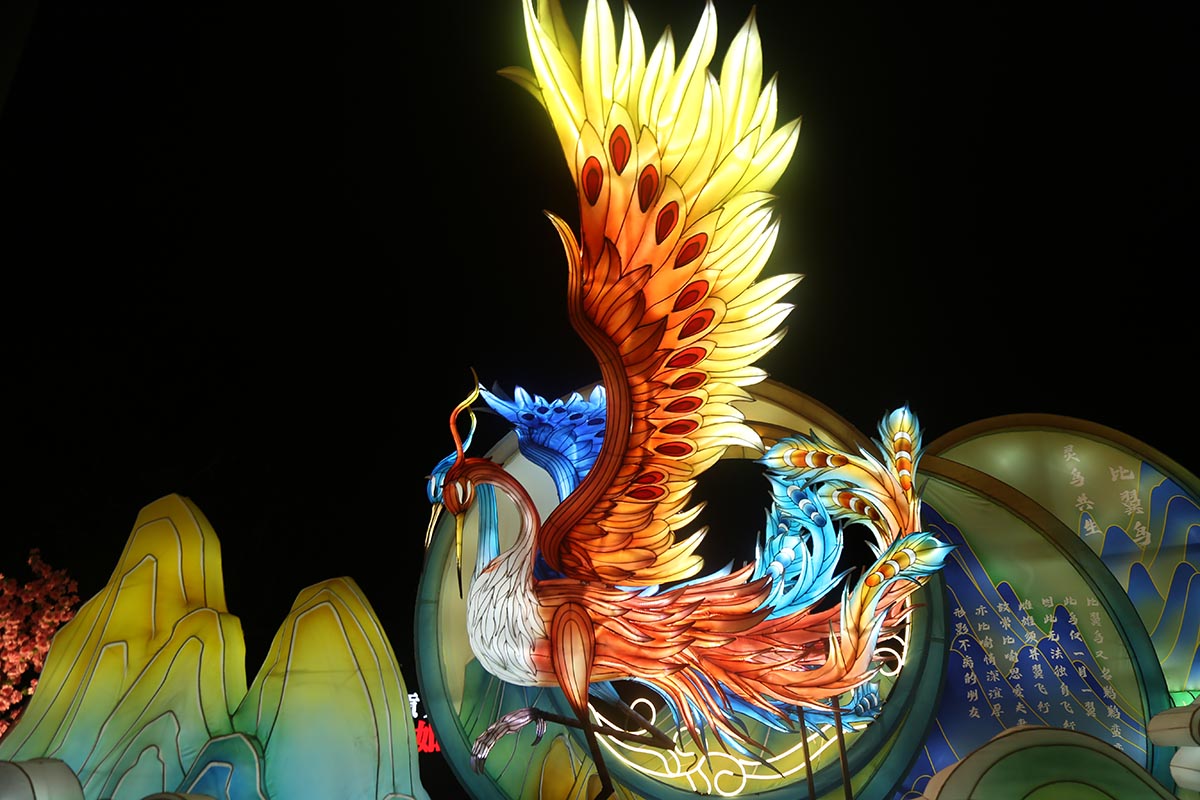
The scene is built as three independent elements: two bird figures in a coordinated flying pose, lit internally on low-voltage outdoor-rated runs, and a decorative backdrop carrying a moon disc, cloud forms and lettering. The birds are mounted either on concealed supports rising from the base or directly to the backdrop frame, depending on the site. Painted silk surfaces carry a UV-resistant treatment, and the pair is dimensioned so that the composition holds from the direction visitors actually approach from.
Two birds is not one bird made twice
In this species the male and female differ completely: the male carries an elaborate palette with prominent wing features and facial markings, while the female is a subdued brown-grey bird with a distinctive eye marking as her main pattern. Any lantern version has to reproduce that difference, because the pair means what it means because the two are distinct.
- Keep the female restrained. The single most common error is making both birds equally colourful, which removes the contrast and turns the piece into a matched pair of decorative birds. The female should read as brown-grey with her eye marking and little else.
- Do not try to reproduce iridescence in fabric. The male’s plumage has an optical quality that silk under internal light cannot reproduce, and attempts to do so produce a muddy green-purple surface. The workable approach is flat colour blocks with clean boundaries, graded within each block, which reads as a vivid bird at viewing distance even though it is not physically iridescent.
- Concentrate the saturation in one area. A bird with five fully saturated colours competing over its whole body reads as noise. Picking one region for the strongest colour and letting the rest drop a step gives the eye a place to land.
- Keep the white facial markings crisp. They do more for species recognition at distance than any body colour, and they are also the first detail to blur when light bleeds through the silk.
Scale matters here too. A pair at exactly the same size reads as a repeated unit; giving the male a slightly larger build than the female matches the species and immediately stops the duplication effect.
Flying poses and what holds them up
A flying pair is a structurally different piece from a pair of standing birds, and most of the difference is in how the figures are carried.
- The support should be concealed behind the body, from the main viewing direction. A bird in flight is usually supported on a slim tube or rod connected at the body or tail. Placing it so that the bird covers its own support from the approach angle is what makes the pose read as flight rather than as a bird on a stick; the same piece seen from behind will always show the support, which is why the viewing direction has to be agreed early.
- An open wing is a wind surface. Extended wings load the support in a different way from a closed body, and the fixing has to be designed for that rather than for the dead weight of the figure. On exposed sites, several smaller coordinated birds are easier to make safe than one large bird with very wide wings.
- The gap between the two birds is part of the structure. The spacing that looks right in the composition also determines how the two are braced relative to each other. If they share a support frame, the frame follows the composition; if they are independently mounted, the spacing is free but the site has to accommodate two bases.
- Build the wings as replaceable elements. On flying pieces the wing tips are the most exposed part of the piece, and being able to replace a wing unit without remaking the body is worth designing in from the start.
The backdrop is a structure, not scenery
The moon, cloud forms and lettering behind the birds are usually described as decoration, but they are doing a structural job: they give the pair something to be in front of. Without a backdrop, two flying birds sit in open air and read as suspended objects. With one, the composition has depth and the birds have a plane to move across.
- The backdrop is the largest wind surface in the piece. A flat panel of any size will catch more wind than the birds, so its bracing or ballasting is the primary structural question on the whole installation, not a secondary one.
- The moon disc and the clouds should differ in transparency. A luminous moon against opaque clouds reads as a moon. If both glow at the same level, the backdrop becomes one bright panel and the birds lose their background.
- Lettering on a backdrop follows the same rules as any lit character. Strokes lose definition at night, and fine strokes close up. On backdrop lettering the practical answer is usually simplification: fewer strokes, wider strokes, and the understanding that from a distance the lettering reads as texture before it reads as words.
- Keep the birds clear of the lettering. Any overlap between a bird and text puts two high-contrast elements on top of each other, and both suffer. Position the birds against the open area of the backdrop.
Symmetry, and why a mirrored pair looks like a sticker
A pair subject almost invites mirror symmetry — the two birds facing each other in a perfect arrangement. It is also the fastest way to make the piece look manufactured, because the eye recognises a reflection immediately and stops reading the image.
| Arrangement | Effect |
|---|---|
| Perfect mirror, same height, same angle | Reads as a reflection. The eye resolves it in one glance and the piece stops holding attention. |
| Mirrored poses at different heights | Better, but still reads as two of one thing; the imbalance looks accidental rather than designed. |
| Coordinated poses, offset front to back | A pair. Depth replaces symmetry, and the composition changes as the visitor walks past. |
| One leading, one following, wingbeats out of phase | Movement. The two figures read as travelling together rather than being arranged together. |
The most reliable adjustment is depth. Setting one bird forward and one back with a deliberate offset gives the composition a diagonal, and a diagonal keeps changing as the visitor approaches. Beyond that, giving the two figures slightly different wing angles is enough — wingbeats out of phase look like flight, wingbeats matched look like a graphic.
Where the piece is commissioned, and how it gets photographed
This subject is bought for a set of occasions that all involve people standing in front of it, and the composition should be set with that in mind rather than for a plan view.
- Weddings and engagement events. The pair is a standard element in Chinese wedding settings, and the piece is usually specified with a photo position in front. That means a clear standing area, the backdrop set behind, and the birds arranged so a couple in the frame does not cover either of them.
- Spring Festival and cultural programmes. The pair is a traditional motif with a documented meaning, which makes it useful as an interpreted exhibit as well as a decorative feature.
- Lane and street installations. In commercial or cultural districts the piece is often set overhead or above an entrance, where the backdrop carries the structure and the birds sit clear of head height.
- Interior and atrium use. Warm-red and gold palettes alongside this subject read well indoors, and in a controlled light environment the fine detail on both birds survives much better than it does outdoors.
For all of these, the practical specification point is the same: give us the direction people arrive from and where the camera is expected to stand. The composition is set against that, and a piece arranged for the wrong approach direction never looks right afterwards.
Specifications
| Attribute | Details |
|---|---|
| Bird length | 1 m – 3 m per figure, with the male built slightly larger than the female |
| Backdrop | 2 m – 5 m wide carrying moon disc, cloud forms and lettering as separate lit zones |
| Pose | Coordinated flying poses, offset in depth rather than mirrored |
| Structure | Weatherproof metal armature; concealed supports behind the body from the main viewing direction; braced or ballasted backdrop frame |
| Lighting | Low-voltage outdoor-rated LED; separate lighting levels for moon disc and clouds; no visible external cable |
| Colour | Male in flat graded colour blocks, female restrained brown-grey with a clear eye marking; saturation concentrated in one region |
| Materials finish | UV-resistant painted silk; CE / UL electrical components |
| Weather rating | Outdoor-rated; wing units replaceable in service |
| Applications | Weddings and engagement events, Spring Festival and cultural programmes, commercial and cultural districts, atrium and interior feature pieces |
Frequently Asked Questions
Related Products and Designs
Other Chinese symbol pieces: the fortune bag lantern, the blessing lantern and the plum blossom branch with birds.
Bird and animal scenes: the plum blossom branch and, for a narrative piece aimed at families, the ugly duckling display. Structures that frame a route are on the festival lanterns page.
Send the approach direction, the photo position, the setting and any reference composition through the contact form, and we will return a layout with the offsets and lighting levels resolved.
Specifications coming soon. Contact us for detailed information.
You May Also Like
Related Products

Animal Lanterns
Suspended Fish Lantern Gateway — Giant Hanging Fish Lantern and Entrance Set
View Details →
Questions
Frequently Asked Questions
Interested in This Product?
Get a custom quote within 24 hours. Our team is ready to help.