Massive Peacock Lantern Installation – Festival Centerpiece Display

Massive Peacock Lantern Installation – Festival Centerpiece Display
A peacock lantern does a job that a standing figure cannot: the tail fan turns into a 30 m wide wall of light that reads from the far end of a venue, holds a colour programme across its whole surface, and gives…
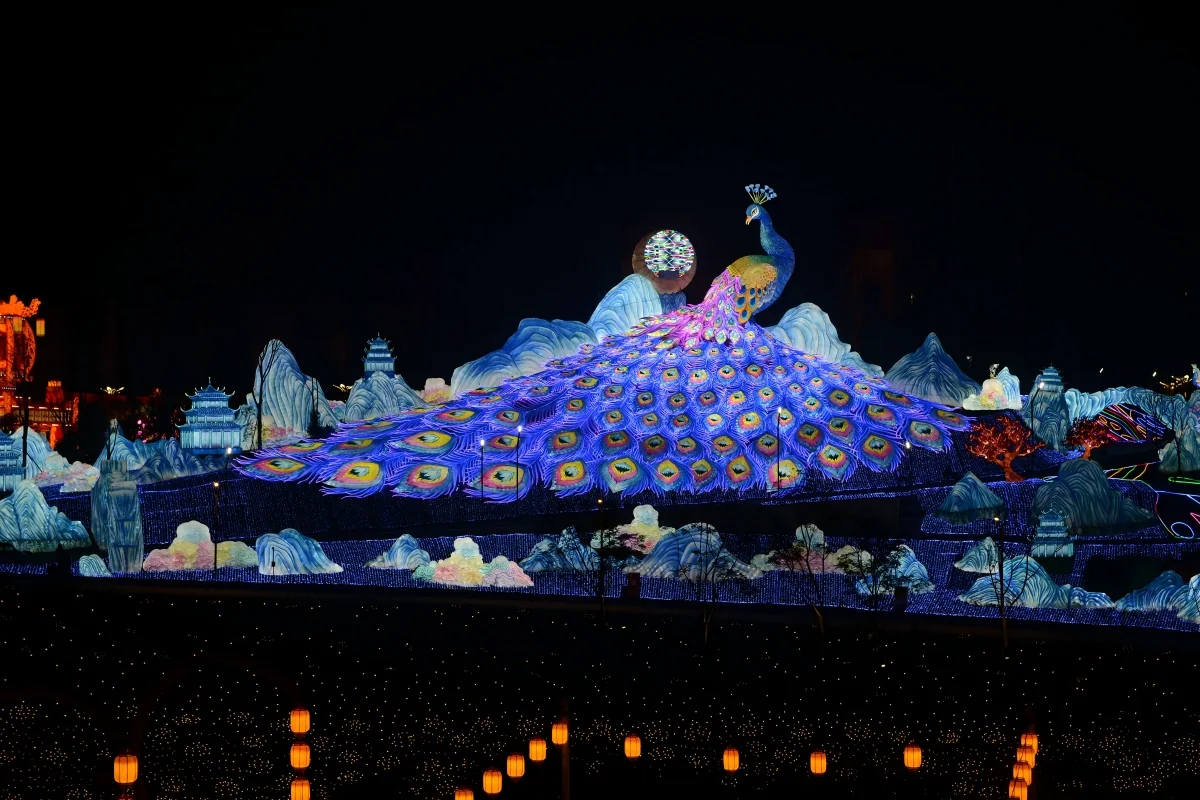
A peacock lantern does a job that a standing figure cannot: the tail fan turns into a 30 m wide wall of light that reads from the far end of a venue, holds a colour programme across its whole surface, and gives visitors something to photograph at a distance. This installation takes that idea all the way — an oversized peacock with a fan spanning 30 m and beyond, lit by programmable RGB LED and set into a scene of mountain forms, water and traditional architecture, so the bird is the brightest thing in a landscape rather than an object on a plinth.
It is built in Zigong, where the lantern craft is a local tradition: the body and the fan are shaped on internal frames, covered by hand and painted by the same artisans who make the smaller pieces on this site. For a festival that needs one unmistakable image — the photo everyone posts, the shot on the poster — the fan is what does the work, because a flat plane of lit colour is legible from three times the distance a figure is.
Why a Peacock Reads Differently From Other Lantern Figures
Dragons, animals and phoenix figures all occupy space in three dimensions — you walk around them and their silhouette changes. A peacock works the opposite way. Nearly all of the visual information sits on one plane, the fan, and that flatness is exactly what makes it useful:
- It is legible from far away. A 30 m plane of colour can be read from the far side of a festival ground, which a 4 m figure cannot.
- It backs a stage or a stage-like space. The fan gives a lit backdrop without needing a screen, and the body stands to one side rather than blocking the middle.
- It anchors the photograph. Visitors stand in front of it and the fan fills the frame — which is why this kind of piece keeps turning up as a venue’s signature image.
- It takes a colour programme well. A large continuous surface shows a gradient or a chase far better than a small figure does.
If your site needs a piece people walk through, a corridor or a walk-in tunnel is the better tool. If it needs a single landmark that photographs from any distance, the fan wins. Other avian themes on this site work to different rules — the colourful phoenix lantern reads as a figure with a plume, while a phoenix centrepiece carries its impact in the body rather than in a flat fan.
The Tail Fan — How a 30 m Span Is Built and Braced
A fan this wide is a structure before it is a picture, and the engineering is mostly about one thing: wind load on a large flat surface. The frame is fabricated in modular sections so it can travel in standard containers, and the fan is braced back to hidden tie points behind the display so that no visible support crosses the fronts where visitors and cameras are.
| Structure | Internal frame, hand-covered and hand-painted; modular sections for container transport |
| Overall footprint | L 35 m × W 15 m × H 12 m, adjustable to the site |
| Tail fan span | 30 m and above, extendable |
| Lighting | Programmable RGB LED, DMX controlled, with remote operation |
| Power | 220 V or 380 V, roughly 15 kW for the full installation |
| Protection | outdoor-rated for outdoor use |
| Installation | 7–10 days with a team of 8–10 technicians |
| Customisation | Scale, palette, animation patterns and scene elements all adjustable |
Two siting decisions matter more than the rest. First, which way the fan faces — a flat 30 m surface should not face the prevailing wind across open ground, so the fan is usually turned to look across the venue’s main axis rather than into the weather. Second, how far back the visitor stands, because the fan needs viewing distance to be read as a whole; a fan placed against a wall loses its subject.
Designing the Eye Spots So the Fan Doesn’t Turn to Noise
The plumage carries hundreds of individually crafted eye spots, and the difference between an impressive fan and a chaotic one is how they are grouped:
- Bands, not scatter. The eyes are arranged in rings out from the body, so the eye reads the fan as a pattern at distance and as individual eyes up close.
- Colour separated by ring. Adjacent rings run different palettes, which keeps the surface from flattening into one colour when the whole fan is at full brightness.
- A quieter outer edge. The silhouette edge is kept simpler and brighter, so the fan keeps its shape against a dark sky.
- The animation respects the rings. Chases and fades run along the rings rather than across them, which is what makes the fan look like it is breathing rather than flickering.
Using Water and Reflection as Part of the Composition
Where the site allows it, the installation is set over water and the reflection does the rest: the fan is repeated below, the visible height of the piece doubles without building anything taller, and a still surface turns the whole display into a complete shape rather than a half one. On a still pond the reflection is clean; on an exposed channel, wind chop breaks it up, and the design compensates with lit elements low in the composition so there is always a band of light at the water line. Water-based pieces on this site are planned the same way — see the phoenix and moon water lantern set and the floating boat water lantern for the floating version of the idea.
Where This Installation Fits
The fan format suits sites where the approach is long, the view is wide and photographs are taken from a distance:
- Botanical gardens and lakeside parks — a natural fit where the fan can sit over water and be approached along a path.
- City festivals and lantern festivals — the landmark that marks the main ground or the end of the route.
- Theme parks and cultural exhibitions — a scene rather than a single animal: mountains, architecture and cloud forms behind the bird.
- Grand openings and corporate events — a lit backdrop with a colour programme that can follow a brand palette.
- Fairgrounds and promenades — a fixed photo point on a walking route, with the body turned to face the flow of visitors.
Where a site wants the same scenery language at a smaller scale, the giant Chinese scroll display and the architecture lantern scene reuse the mountain-and-building backdrop without the fan.
Frequently Asked Questions
Related Displays and Resources
- Colourful Phoenix Lantern — the same avian theme built as a figure with a plume rather than a fan
- Phoenix Lantern Festival Centrepiece — a centrepiece whose impact sits in the body
- Phoenix & Moon Water Lantern Set — the floating version for open water
- Floating Boat Water Lantern — a moving water route to pair with a static reflection piece
- Giant Chinese Scroll Lantern Display — the mountain-and-architecture scenery without the fan
- Festival Lantern Range — the rest of the outdoor installation range
- Chinese Lantern Festival Planning & Sourcing Guide — site, power and programme planning before you brief a build
Send us the site plan with the fan position marked, the power available and the direction visitors approach from, and we will come back with a fan layout, a colour concept and an installation outline. Contact us with drawings or site photographs — that is usually enough to size the piece.

You May Also Like
Related Products

Animal Lanterns
Suspended Fish Lantern Gateway — Giant Hanging Fish Lantern and Entrance Set
View Details →
Giant & Large-Scale Lanterns
Giant Monkey King Lantern — Sun Wukong Festival Sculpture
View Details →Questions
Frequently Asked Questions
Interested in This Product?
Get a custom quote within 24 hours. Our team is ready to help.