Phoenix Lantern Corridor Display — Processional Phoenix Lanterns for Festival Paths
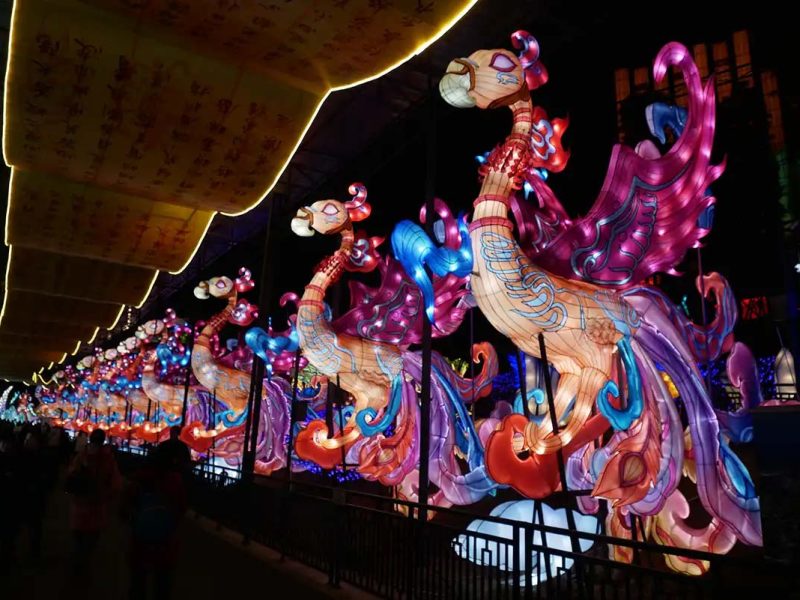
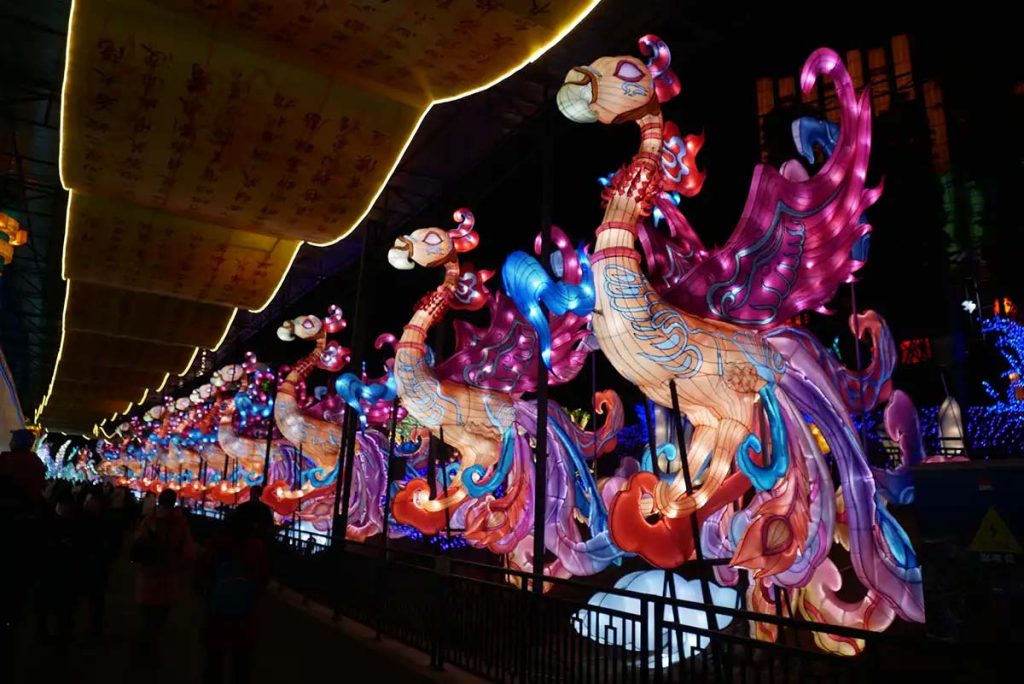
Some displays stop people in their tracks. This one keeps them walking. A phoenix lantern corridor lines both sides of a path with matching illuminated birds, each one a full sculpture with raised head and fanned tail, facing inward so visitors move through the middle of the scene. The birds repeat at regular intervals — close enough to feel surrounded, far enough apart that every phoenix gets its own photograph.
The effect works because the phoenix is a forward-facing symbol. People already associate it with renewal and celebration, so a corridor of phoenixes reads naturally as an entrance, a processional route, or the opening stretch of a lantern trail. Venues use it where they want guests to slow down and look around rather than rush past: the first 80 metres after a zoo entrance, the walk from a parking lot to a festival gate, the covered arcade of a shopping mall during Lunar New Year, or the lakeside path of a botanical garden.
Each unit is built around a steel frame with LED light fixtures and a high-density silk fabric skin. The plumage is hand-painted in layered pigment so the colour shifts under warm-white light — gold at the chest, rose and violet along the wings, indigo at the tail tips. Birds are typically produced in two mirrored poses so the corridor reads as a balanced pair. Standard single-bird height is 2.5–3.5 m; the corridor can be scaled to 5 m birds for wide boulevards or reduced to 1.8 m for indoor arcades.
Factory-direct from Zigong, shipped and installed worldwide.
Specifications
| Parameter | Value |
|---|---|
| Product Name | Phoenix Lantern Corridor Display — Processional Phoenix Lanterns |
| Type | Modular corridor of freestanding phoenix lantern sculptures |
| Configuration | 6, 10, 16 or custom number of birds in mirrored pairs |
| Single Bird Height | 2.5 m – 3.5 m standard (1.8 m – 5 m custom available) |
| Bird-to-Bird Spacing | 4 m – 8 m typical, adjustable to path width |
| Frame | Galvanized steel skeleton, anti-corrosion treated |
| Skin | High-density silk fabric, hand-laid and hand-painted |
| Finish | Multi-layer pigment in gold, rose, violet and indigo, UV-stable |
| Lighting | Internal warm-white LED modules, IP65 outdoor rated |
| Control | Simple on/off or DMX512 programmable for timed sequences |
| Power | 110/220 V AC, single phase, ~0.3 kW peak per bird |
| Weatherproofing | IP65 — continuous outdoor display ready, -25°C to 50°C |
| Installation | Ground-anchored; 2-person crew per bird, 1–2 hours each |
| Customisation | Bird height, spacing, colour palette, path length, paired vs. single arrangement |
Key Features
1. Processional Layout That Moves Crowds
The corridor format turns a static display into a route. Visitors enter at one end and naturally walk the full length, passing every bird at close range. For venues that sell tickets by the trail, this layout increases dwell time and the number of photos shared.
2. Each Bird Is a Complete Sculpture
Unlike long body lanterns that only look good from the front, every phoenix in this corridor is finished on all sides. The tail fans out, the wings are shaped in three dimensions, and the head is turned slightly toward the path so the birds appear to watch guests walk by.
3. Mirrored Pairs for Visual Rhythm
Birds are produced in left-facing and right-facing pairs. Alternating them along a path creates a natural rhythm and makes the corridor feel like a designed gateway rather than a random line of decorations.
4. Scales from Indoor Arcade to City Boulevard
The same design works at 1.8 m under a mall ceiling or at 5 m along a city street. The steel frame and anchoring system are engineered per height, and the spacing adjusts to the venue path.
5. Hand-Painted Silk, Not Printed Fabric
The colour gradient is built up with hand-applied pigment on silk. Under LED light the surface glows with depth rather than flat colour, which is what separates a lantern display from an inflated or plastic alternative.
6. Festival-Tested Hardware
IP65-rated LED fixtures and anti-corrosion treated steel mean the corridor can stay outdoors for multi-month runs. Installations of this range have operated in winter festivals, humid botanical gardens and coastal event sites.
Applications
Lantern Festival Entrance Trail
Place the corridor at the entry to a lantern festival and it becomes the first immersive moment. Visitors photograph the birds before they reach the paid sections, which turns the entrance itself into marketing content.
Zoo and Botanical Garden Night Routes
Zoos use this layout along existing footpaths, lighting the way between animal enclosures and themed gardens. The phoenix theme fits conservation messaging about rare and beautiful species.
Shopping Mall Holiday Walkway
During Lunar New Year, Christmas or Mid-Autumn, malls install shorter corridor sections in covered walkways. The 1.8–2.5 m scale fits standard ceiling heights and fire-safety clearances.
Theme Park Processional Street
Parks place the corridor along the main street guests use when entering or leaving evening events. It extends the themed environment beyond ride queues and stage areas.
City Celebration Parade Route
For municipal festivals, the corridor can anchor a static parade route or line a pedestrianised street. It works as both decoration and crowd-control landscaping, keeping visitors in the designated walking zone.
FAQ
Q: How many birds do I need for a corridor?
A: A 30-metre path usually takes 6–8 birds (one every 4–5 metres). A 100-metre festival trail often uses 16–20 birds. We adjust spacing so the display feels full without blocking emergency access or foot traffic.
Q: Can the birds be different mythological creatures?
A: Yes. The same corridor engineering works for dragons, qilin, cranes or custom mascots. Mixed-species corridors are common for zoos and theme parks that want a “mythical forest” or “Asian folklore” theme.
Q: Does the corridor work on uneven ground?
A: Yes. Each bird mounts on an adjustable ground plate that handles small slopes and uneven paving. For steep paths or soft ground we supply extended anchors or concrete footing guidance.
Q: Is it suitable for long-term outdoor display?
A: Yes. The steel frame is anti-corrosion treated, the LED modules are IP65-rated, and the silk skin is UV-stabilised. We have corridor displays in continuous outdoor service across a range of climates.
Q: Can the colour scheme match our festival branding?
A: Yes. The standard palette is gold, rose, violet and indigo, but the plumage can be shifted to red-gold, green-blue, white-gold or a fully custom palette to match your event theme.
Q: How is it shipped and installed?
A: Each bird ships in modular sections (head, body, wings, tail) in wooden crates. We provide assembly drawings and can send an installation crew. A typical 10-bird corridor installs in 2–3 days with a 4-person crew.
Q: What path width do I need?
A: Allow at least 3 metres clear width between the birds for comfortable two-way foot traffic. Wider paths (5–6 metres) let visitors stop for photos without blocking the flow.
Internal Linking Suggestions
- Animal Lanterns collection — full species catalog including phoenix, dragon, qilin and crane
- Colorful Phoenix Lantern — single-bird iridescent phoenix sculpture for focal points
- Phoenix Lantern Festival Centerpiece — main-stage phoenix with harp-shaped stage
- Phoenix Lotus Bloom Lantern — companion piece for water and garden scenes
- Chinese Lantern Ceremony — event installation and venue planning service
- Request a free 3D design and quote
Image Filenames
Questions
Frequently Asked Questions
Interested in This Product?
Get a custom quote within 24 hours. Our team is ready to help.